The Tragedy of Morality in Breaking Bad’s Criminal Justice System
Examining Ethical Dilemmas and Systemic Flaws

Breaking Bad, AMC’s acclaimed crime drama, captures a profound tragedy at the heart of morality and justice. While Walter White’s descent into criminality exposes his personal failures, the show also highlights the inability of the criminal justice system to uphold its ideals in the face of human frailty and societal shortcomings. Breaking Bad directly confronts viewers with the stark reality that both the law and individual morality can fail, leaving devastating consequences for everyone involved.
The series asks its audience to examine how the quest for justice and moral order is consistently undermined by flawed institutions and people. As the narrative unfolds, viewers are left to question not just the guilt of the individuals committing crimes, but also the structural injustices that influence their choices. This intersection of personal responsibility and systemic failure is central to the tragedy that defines Breaking Bad’s exploration of crime and punishment.
The Foundations of Morality in Breaking Bad
Breaking Bad explores how personal ethics are tested and transformed within a world shaped by crime and desperation. The series uncovers how characters justify their actions and confront the practical limits of their own moral values.
Defining Morality Within the Series
Morality in Breaking Bad is portrayed as a flexible, subjective construct rather than a fixed standard. The show scrutinizes how societal norms and personal motivations interact, especially in situations where the legal system fails or is absent.
Key figures like Walter White and Jesse Pinkman face constant pressure to redefine right and wrong in response to hardship and ambition. Vince Gilligan, the creator, crafts scenarios where ethical boundaries blur, illustrating how easily one’s principles can shift over time.
This moral ambiguity is reflected in decisions ranging from small deceptions to violent crime. The line between victim and perpetrator is often deliberately unclear, prompting viewers to question the stability of their own moral assumptions.
Walter White’s Moral Evolution
Walter White’s journey is marked by a gradual shift from a conventional value system to a self-serving morality. Initially acting out of desperation after a cancer diagnosis, he adopts a new ethical code shaped by pride, fear, and survival.
As the series progresses, Walt’s early rationalizations—such as providing for his family—give way to choices rooted increasingly in ego and power. His transformation demonstrates how unchecked pride can erode one’s ethical compass.
Throughout the series, Walt faces moral dilemmas that expose his double standards and rationalizations. By the final seasons, his change is evident: he accepts actions he once condemned, showing how moral values can be redefined by circumstance and ambition.
Ethical Dilemmas and Choices
Breaking Bad emphasizes concrete ethical dilemmas, often forcing characters to choose between loyalty, self-interest, and survival. Decisions rarely present clear right or wrong answers, which reflects the complexity of real-world moral conflicts.
Jesse Pinkman’s struggles highlight this moral complexity. His actions frequently stem from compassion, yet he is drawn into situations where every choice entails ethical compromise. Characters are tested by alliances, betrayals, and moments where their decisions have dire consequences.
These themes are not abstract; they reveal how ordinary people react when confronted with extraordinary circumstances. The show’s narrative structure provides a persistent reminder that morality is not static, but constantly negotiated through individual choices and external pressures.
The Influence of the Criminal Justice System
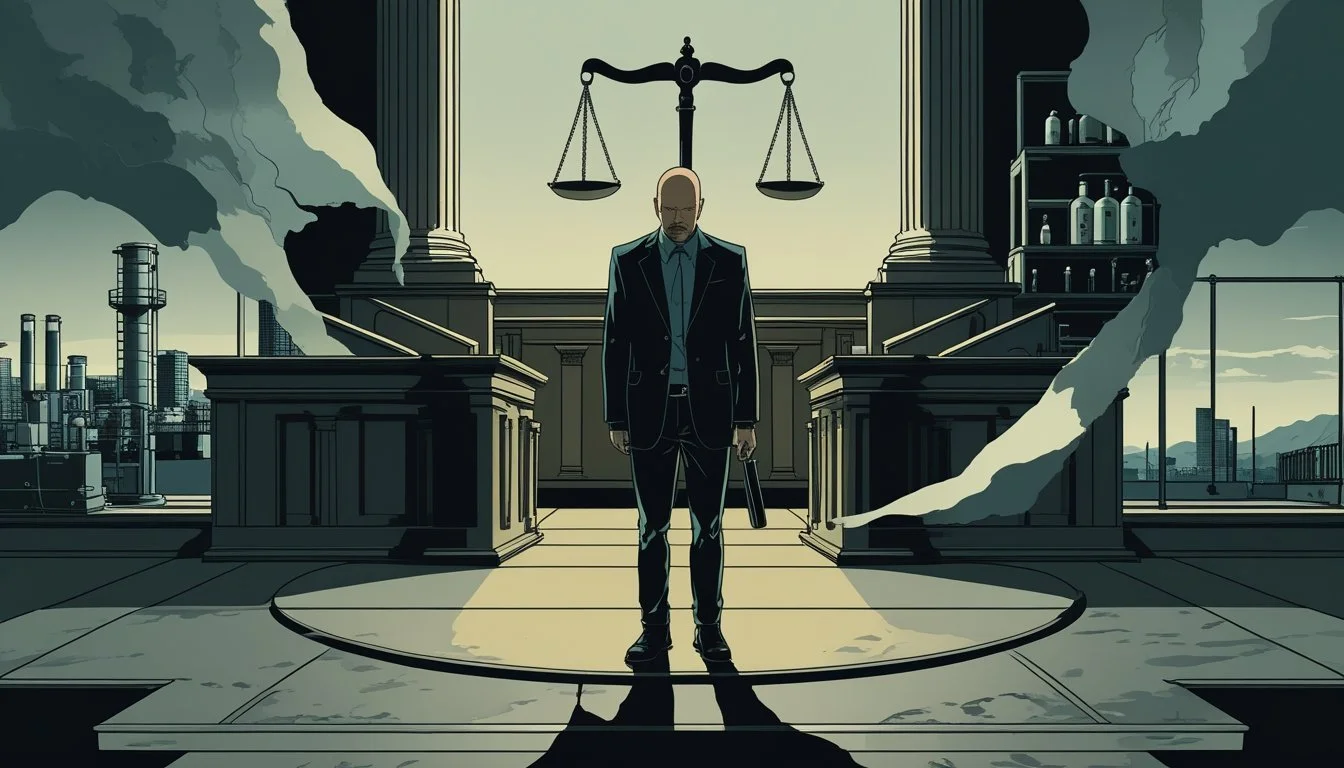
Breaking Bad uses its depiction of New Mexico’s criminal justice system to reveal complex moral questions and the limitations of law enforcement. By following characters on both sides of the law, the series highlights blurred ethical boundaries and systemic weaknesses.
Representation of Law and Order
Law and order in Breaking Bad are shown as both necessary and imperfect forces within society. The criminal justice system is often unable to address the rapidly changing tactics of criminals like Walter White.
Legal boundaries become negotiable, as the series presents rules and regulations not as shields for justice, but sometimes as obstacles. Characters often navigate or exploit these boundaries rather than rely on them for safety or resolution.
The show demonstrates how individuals can slip through legal cracks. While the system aims to deter crime, its processes—such as lengthy investigations and legal loopholes—sometimes allow criminal figures to gain influence and escape accountability.
DEA Agents and Law Enforcement
DEA agents in Breaking Bad are portrayed as diligent yet fallible actors. Hank Schrader stands out as a dedicated law enforcement professional in New Mexico, deeply committed to the pursuit of justice.
Despite his dedication, Hank and his colleagues are frequently caught off-guard by the ingenuity and boldness of the criminals they face. Investigations into methamphetamine production are hindered by limited resources, bureaucratic red tape, and organizational blind spots.
The series also addresses the theme of corruption and personal biases. Some law enforcers, intentionally or not, make compromises that confuse moral judgment. Law enforcement’s human flaws are juxtaposed against their noble intentions, suggesting that the fight against crime is more complicated than simple legal adherence.
Systemic Failures and Grey Areas
Breaking Bad exposes systemic failures where standard procedures fall short. The criminal justice system struggles to keep pace with adaptable criminal enterprises, highlighting a gap between law and evolving forms of crime.
Legal processes can inadvertently protect wrongdoers through technicalities or insufficient evidence. Grey areas emerge when the law’s rigidity fails to account for individual circumstances—sometimes punishing the desperate or innocent while others evade justice.
Moral ambiguity thrives in this environment. Many characters must weigh personal ethics against legal expectations, resulting in actions that defy clear judgment. The show’s portrayal of systemic limitations invites viewers to question notions of justice, consequence, and responsibility.
Heisenberg: Transformation and Tragedy
Walter White’s metamorphosis into Heisenberg is defined by a shift from vulnerability to power and moral disintegration. This journey is marked by ambition, personal justification, and mounting consequences that touch everyone around him.
The Emergence of Heisenberg
Walter White begins as an unassuming chemistry teacher facing terminal illness and financial hardship. These pressures push him to manufacture methamphetamine, but what starts as a desperate attempt to secure his family's future soon escalates beyond necessity.
The persona of Heisenberg represents more than a name—it is an alter ego embodying calculated risk and cold resolve. Walter adopts new behaviors: secrecy, manipulation, and a willingness to threaten or harm. As Heisenberg, he navigates the criminal world using chemistry expertise and strategic thinking.
This identity shift is not gradual but marked by clear turning points. Notably, when he proclaims, “I am the one who knocks,” Walter leaves behind most pretenses of moral justification. The Heisenberg persona becomes the dominant force, reshaping his identity and approach to life.
Pride, Power, and Corruption
Heisenberg’s rise is fueled not just by survival, but by personal pride and a desire for recognition. List of core motivations:
Pride: Walter resents past slights and lost opportunities, especially regarding his former business partners.
Power: Once powerless, he seizes control in both his family life and the drug trade.
Greed and revenge: Success in the drug world inflates his sense of entitlement and leads to retaliation against rivals.
These motivations corrupt his moral compass. He justifies decisions by claiming they are for his family, but his actions become increasingly self-serving. The lines between defender and aggressor blur, making his journey a study in the dangers of unchecked ambition.
Characters close to Walter—such as Jesse Pinkman and Skyler White—become entangled in his schemes. Their lives are impacted by his shifting priorities, and the legal system is shown as ineffective at containing his rise.
Consequences of Breaking Bad’s Choices
The ramifications of Walter’s choices are both personal and far-reaching. As he wields more power, the fallout touches his family, partners, and the wider community. Fear becomes a pervasive tool, with threats used to silence and control.
Relationships deteriorate as trust is eroded. A summary of outcomes:
Stakeholder Impact Family Fear, alienation Jesse Pinkman Manipulation, trauma Law Enforcement Outmaneuvered, ineffective Community Meth crisis escalated
The tragedy is not just Heisenberg’s downfall, but the collateral damage inflicted on others. In striving to dominate his circumstances, Walter White ultimately embodies the moral collapse he once sought to avoid.
Morality, Family, and Personal Relationships
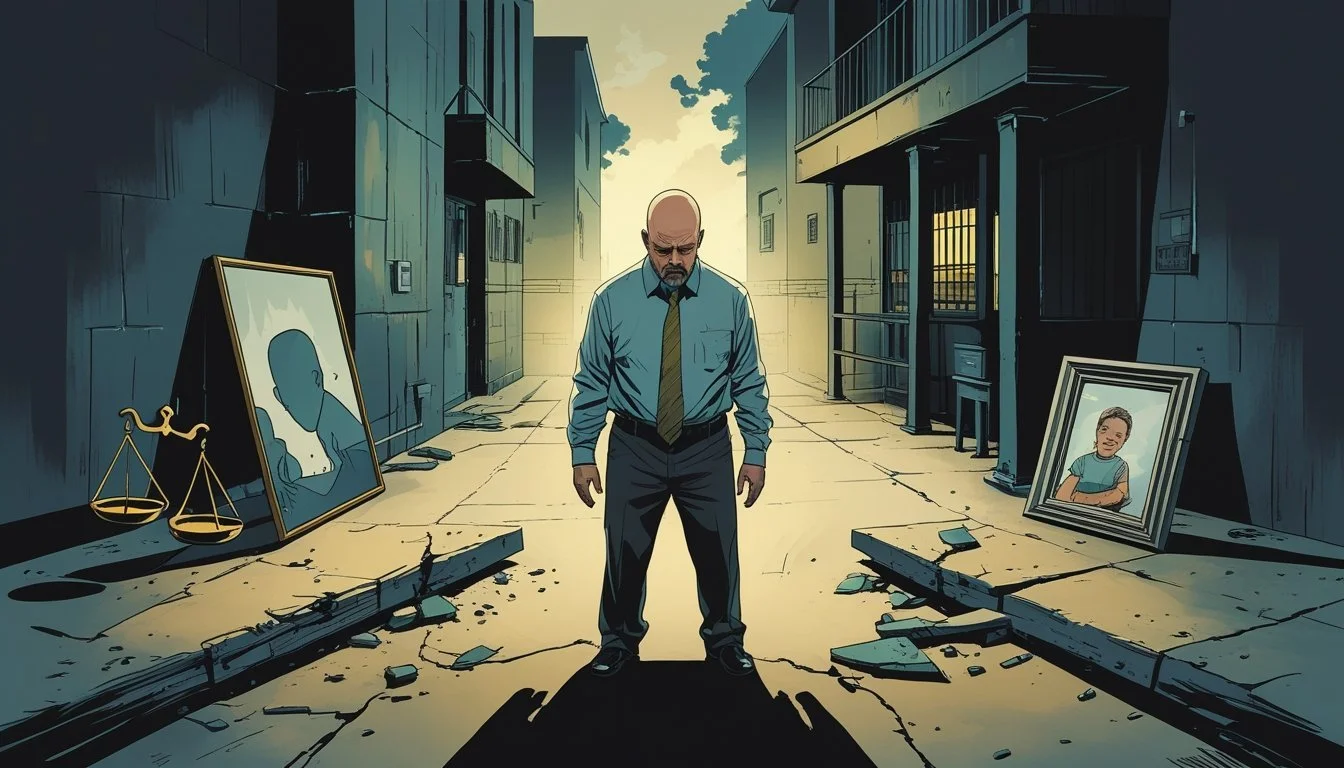
In Breaking Bad, the boundaries between right and wrong shift as characters balance familial responsibilities and personal ambition. The series highlights how Walter White’s criminal choices impact his relationships, especially with Skyler, and tie deeply into issues of masculinity, illness, and sacrifice.
Walt and Skyler’s Evolving Relationship
Walter and Skyler White’s marriage undergoes significant strain as Walt descends into the criminal world. Initially, Skyler’s primary concern is Walt’s health, particularly his lung cancer diagnosis, which prompts her to engage in praying and seeking support.
However, Walt’s secrecy, criminal activities, and increasing manipulation erode trust. Skyler transitions from a concerned wife to a participant, laundering money to protect the family. The marriage becomes a battleground, with Skyler forced to weigh her own morals against loyalty to Walt and the well-being of their children.
Skyler’s responses are shaped by Walt's shifting masculinity and control. His criminal success gives him newfound confidence, but also alienates those closest to him. Their relationship demonstrates how moral choices ripple outward, affecting intimacy and trust at home.
Family as Motivation and Downfall
Walter justifies his actions by claiming he is providing for his family, especially after his lung cancer diagnosis. He repeatedly uses his role as husband and father to rationalize criminal behavior. This motivation, initially noble, is corrupted as his ambition and ego grow.
The family unit serves both as motivation and eventual downfall for Walter. His crimes put Skyler and their children in increasing danger, pushing Skyler into criminal complicity and creating deep anxiety and conflict. The family is drawn into a cycle of fear and mistrust.
Efforts to protect his loved ones directly result in their suffering. The breakdown of familial bonds and Walt’s isolation highlight the tragedy at the heart of his choices. The series consistently returns to the theme that actions justified for family can ultimately be their undoing.
Parenthood and Sacrifice
Parenthood in Breaking Bad is depicted as a complex struggle between self-interest and genuine sacrifice. Walter initially embraces extreme solutions, believing that providing financially is a parent’s main duty. This view ignores emotional needs and ethical boundaries.
Walt and Skyler each make sacrifices for their children, but at great personal and moral cost. Walt’s choices frequently endanger his family’s safety and reputation. Skyler’s participation, albeit reluctant, adds to the sense of shared responsibility within the household.
The show raises questions about how far a parent should go to secure their children’s future. In striving to protect his children through illegal means, Walter undermines the very foundation he claims to defend, revealing the risks and limits of parental sacrifice.
Jesse Pinkman: Guilt, Redemption, and Judgment
Jesse Pinkman stands as one of Breaking Bad’s most complex characters, wrestling with intense guilt and shifting moral values. Through his partnership with Walter White, his choices often reflect the ambiguous nature of morality within the criminal justice system.
Jesse’s Struggles With Moral Values
Jesse’s sense of right and wrong is in constant conflict with the realities of the crime drama world. He resists major atrocities, such as harming children, and often questions the ethics behind his own actions.
Unlike others involved in the drug trade, Jesse feels guilt for his crimes. His emotional reactions after key events, like Jane’s death, highlight his struggle to reconcile his actions with his conscience.
Among his peers, Jesse often displays more empathy and hesitation, setting him apart and suggesting an underlying desire for redemption.
Partnership With Walter White
Jesse’s partnership with Walter White dramatically shapes his fate and moral outlook. Under Walter’s influence, Jesse becomes involved in crimes that he previously would have rejected.
Key incidents, including the murder of Gale and Victor’s death, show Jesse engaging in acts that haunt him. Walter often manipulates Jesse’s guilt for his own purposes, further complicating Jesse’s understanding of justice and judgment.
Their relationship is defined by both loyalty and betrayal. Jesse’s identity is continually reshaped by this unstable alliance, pushing him deeper into moral ambiguity.
Redemption and Guilt
Jesse’s overwhelming guilt fuels his attempts at redemption throughout the series. He seeks to make amends by providing for Andrea and Brock, and by rejecting further violence wherever possible.
He is burdened by the consequences of his participation in the drug trade, suffering both emotionally and physically. Jesse’s search for justice is shaped by his need for forgiveness, though it is rare for him to find much relief.
Even after escaping captivity, his journey is marked more by trauma and regret than any real escape from the judgment he faces, making his story a critical lens for examining morality in the criminal justice system.
Corruption, Violence, and the Underworld
The criminal underworld in Breaking Bad is driven by a relentless drug trade, fueled by violence and corrupt alliances. Individuals like Gus Fring and Saul Goodman exemplify how morality breaks down under the weight of criminal enterprise and power.
The Drug Trade’s Corrosive Impact
Meth production and distribution fundamentally reshape Albuquerque’s social order. Walter White’s transition from high school chemistry teacher to a dangerous meth cook leads to violent turf wars and collateral damage for both bystanders and participants. Drug dealers enforce loyalty and obedience through intimidation and deadly force.
Criminality spreads beyond those directly involved. Families, law enforcement, and even innocent civilians suffer the fallout. The show details the unchecked violence: shootings, bombings, and threats are regular tools for those seeking dominance.
Key features of the drug trade’s impact:
Perpetual fear among rivals and associates
Normalization of violence and retribution
Erosion of community trust and stability
The meth empire extends corruption into legitimate business and public institutions, revealing the thin dividing line between law-abiding society and organized crime.
Gus Fring and Criminal Hierarchies
Gus Fring operates under a veneer of respectability, managing fast food restaurants while running a highly structured drug operation. Unlike erratic counterparts, Fring enforces a corporate discipline in his criminal enterprise, demanding precision and loyalty from subordinates.
He insulates himself from risk through layers of intermediaries and strict protocols. His approach to violence is calculated; Fring eliminates threats ruthlessly, but only when it serves a strategic purpose. This business-like model keeps him above suspicion for years.
Table: Gus Fring’s Organizational Methods
Tactic Purpose Compartmentalization Limit risk/exposure Vetting of associates Ensure loyalty Strategic violence Deter betrayal Legitimate businesses Mask illegal income
Gus’s example demonstrates that power and structure do not eliminate violence—they simply make it more efficient and harder to detect.
Saul Goodman’s Moral Flexibility
Saul Goodman rises as the go-to criminal lawyer by bending legal and ethical norms. He connects drug dealers and meth cooks to services that launder money, create false identities, and evade prosecution. Every client’s situation is a puzzle where morality becomes secondary to legal loopholes.
He rationalizes unethical actions as “helping people” or just “doing business.” Saul manipulates the justice system, leveraging plea bargains, bribery, and technicalities. This pragmatic flexibility is his primary survival tool.
List: Saul Goodman’s Questionable Practices
Facilitating fraudulent business operations
Coaching clients to evade law enforcement
Coordinating hush money and document forgeries
Exploiting loopholes in the legal system
Saul’s involvement blurs the boundaries between defense attorney and accomplice, illustrating the ease with which professionals can become entwined in the underworld’s corruption.
Chemistry and the Science of Crime
Breaking Bad uses chemistry as a central tool for both illegal enterprise and storytelling. Walter White’s mastery of chemical principles shapes the crime world he enters, from manufacturing methamphetamine to employing lethal poisons.
Walt’s Knowledge of Chemistry
Walter White’s background as a high school chemistry teacher enables him to approach crime with scientific precision. His understanding of chemical reactions is not only accurate but often portrayed with attention to detail, reflecting real processes more closely than most other crime dramas.
He applies laboratory techniques—such as purification and titration—to produce methamphetamine of unparalleled purity. This sets his product apart and drives conflict with rivals. Chemistry also gives Walt leverage over the criminal underworld, allowing him to solve problems in ways others cannot anticipate.
Key chemical concepts seen in the series include:
Process Application Crystallization Purifying methamphetamine Extraction Isolating compounds Synthesis Creating meth, ricin
His scientific mindset often turns dangerous, converting science—traditionally associated with progress—into a weapon.
Methamphetamine and Ricin as Plot Devices
Methamphetamine production is the backbone of Breaking Bad’s criminal enterprise. Walt’s blue meth becomes a symbol of his expertise and power. The show’s depiction of meth cooking, while dramatized, references actual chemical methods, such as pseudoephedrine extraction and volatilization.
Ricin, a highly toxic substance, is introduced as a subtle method for assassination. Walt synthesizes ricin from castor beans, demonstrating his willingness to exploit chemistry for lethal means. The use of ricin exemplifies calculated risk, secrecy, and the moral ambiguity of using science for harm.
Both methamphetamine and ricin function as more than just drugs or poisons—they represent the transformation of knowledge into both opportunity and threat. Chemistry, in this context, is both the instrument of crime and the engine of moral complexity.
Notions of Justice, Judgment, and Retribution
Breaking Bad frames its version of justice through intense personal motives and the consequences of subjective morality. The show depicts a moral landscape where decisions about punishment, retaliation, and right or wrong often clash with traditional legal and ethical structures.
Retributive Justice and Revenge
Retributive justice in Breaking Bad is often indistinguishable from simple revenge. Walter White, for example, repeatedly enacts punishment not to restore order, but to demonstrate power or settle personal grievances. His choices shift the story from a morality tale about survival into a morality play about ego and escalation.
Throughout the series, retribution rarely follows legal or ethical guidelines. Victims and perpetrators become blurred as Walter and others justify violent acts as responses to previous wrongs. The system bends to the will of those with the most power or cunning, illustrating how easily the desire for revenge overtakes reasoned judgment.
This persistent cycle of retaliation underscores the tragic nature of justice in the show's universe. Acts meant to balance the scales only deepen the fractures within families, alliances, and the wider community. The lines between avenger and offender blur, challenging viewers to consider where justice ends and revenge begins.
Community Judgment and Social Morality
Community judgment in Breaking Bad forms an informal criminal justice system, separate from courts or law enforcement. Characters are judged by their peers, families, and criminal associates as much as, or more than, by official authorities.
List of key forms of social morality at play:
Public shame when misdeeds are revealed
Silence or complicity from those who look the other way
Social exile for those who violate shared codes
Walter’s transformation is mirrored by the community’s responses—his family’s fear, Skyler’s isolation, and the shifting loyalties within the criminal underworld. These judgments are swift and severe, reinforcing the show’s morality play dynamic, in which actions provoke responses that are both personal and communal.
Breaking Bad’s world uses communal judgment as both a punishment and a deterrent. This informal process highlights how deeply ingrained moral codes can enforce or undermine justice independently of the legal system. The show presents a universe where social morality can be just as punishing as any court ruling.
Broader Philosophical and Societal Themes
The ethical conflicts in Breaking Bad offer a lens for examining moral decision-making and the ambiguity of right and wrong. These dilemmas reflect wider debates in philosophy and society about justice, power, and the consequences of one's actions.
Joshua Greene and Moral Tribes
Joshua Greene’s work, particularly in Moral Tribes, centers on how group loyalty and moral dilemmas play out in societies. In Breaking Bad, viewers see clashes between different “tribes”—from drug dealers to law enforcement—as each group operates according to its own values and justifications.
Greene’s theory of dual-process morality highlights how intuitive emotional responses often conflict with reasoned ethical thinking. Walter White demonstrates this split; his choices oscillate between visceral self-preservation and calculated rationalizations. Greene’s ideas map well onto Breaking Bad’s world, where tribal identities shape loyalties and fuel escalating conflicts.
This framework also helps explain the fractured morality seen in the series, as characters justify criminal acts based on loyalty, survival, or perceived justice. Walter’s actions are not just personal but reflect larger issues of group morality, resonating with Greene’s exploration of how societies handle conflicting tribal values.
Comparisons to Other Crime Thrillers
Breaking Bad often invites comparison with other crime thrillers, such as Batman or classic films focused on vigilantism and moral ambiguity. While Batman, as portrayed in popular media, positions himself as a hero bound by a strict personal code, Walter White blurs the lines between hero and villain.
Both crime thrillers and Breaking Bad use charismatic figures (e.g., Bryan Cranston’s Walter, political leaders, or masked vigilantes) to examine the cost of seeking justice outside the law. Unlike many genre conventions, Breaking Bad resists simple good-versus-evil dichotomies. Instead, it presents a spectrum of motivations and consequences.
This nuanced approach sets Breaking Bad apart from typical thrillers, raising questions about societal complicity, the morality of ends justifying means, and the true nature of justice in an imperfect system.
Legacy and Lasting Impact of Breaking Bad’s Moral Tragedy
Breaking Bad’s depiction of moral decline, especially in its later seasons, left a distinct mark on viewers and the television landscape. The series prompted widespread discussion of ethics and justice within crime dramas, forging a new standard for complexity and realism in the genre.
Audience Reactions and Morality Debates
The series’ exploration of morality, especially through Walter White’s transformation in season five, led to heated debates among viewers. Many questioned if Walter’s actions could ever be justified, or if his choices were simply the logical outcome of systemic failures.
Online forums and social media regularly displayed polarized opinions on justice, punishment, and personal responsibility. The show’s refusal to offer simple answers forced audiences to confront uncomfortable truths about the line between good and evil.
Some viewers identified with characters they would traditionally condemn, pointing to relatability and the seductive pull of ambition and desperation. This complexity gave Breaking Bad its status as more than just entertainment, but a catalyst for examining personal moral perspectives.
Influence on Drama and Popular Culture
Breaking Bad raised the bar for serialized drama, influencing both storytelling and production values across the industry. Its commitment to nuanced character arcs, exemplified by Walter’s moral disintegration, became a blueprint for subsequent series.
The impact is evident in later crime dramas that employ ambiguous protagonists and intricate ethical dilemmas, echoing Breaking Bad’s approach. Shows like Better Call Saul and Ozark drew inspiration from its layered characterization and narrative pace.
References to Breaking Bad’s pivotal scenes, particularly from season five, became fixtures in pop culture. The series’ legacy persists in memes, academic analysis, and recurring discussions among television writers regarding morality in fiction.