
Walter White’s Descent in Breaking Bad Is Shakespearean Tragedy in Modern Form Explored

Walter White’s transformation in Breaking Bad closely mirrors the tragic arcs found in Shakespeare’s classic dramas, turning modern television into a stage for timeless human flaws. The series doesn't just offer crime and suspense; it dives into the psyche of its central character, revealing how ambition, pride, and desperation can unravel an ordinary life.
The drama skillfully combines Walter White’s journey with elements familiar to Shakespearean tragedy—hubris, moral conflict, and inevitable downfall. As the chemistry teacher sinks deeper into the world of drugs and crime, viewers witness not just a personal unraveling, but a reflection on the dangerous consequences of unchecked ambition.
Breaking Bad stands out as a rare example of television that isn’t afraid to depict its protagonist as both victim and architect of his own fate. Audiences are left questioning where sympathy ends and culpability begins, and how one man’s choices set off a chain reaction as compelling as any play by the Bard.
Walter White: The Protagonist’s Complexity
Walter White’s character arc in Breaking Bad is defined by stark transformation, dual identities, and conflicts between personal ambition and moral responsibility. His evolution reflects psychological depth and the challenges posed by economic pressures, family loyalty, and self-perception.
From Mild-Mannered Chemistry Teacher to Drug Dealer
Walter White begins as a high school chemistry teacher living a quiet, unremarkable life. He faces financial hardship, a recent cancer diagnosis, and struggles with feelings of inadequacy due to his working-class status.
He enters the drug trade initially to provide for his family after his death. This decision is not made lightly; it emerges as a result of desperation rather than delinquency. Walter’s expertise in chemistry and methodical approach transform him from novice to a key player in Albuquerque’s methamphetamine market.
The transition highlights the effect of external circumstances on a person’s ethical boundaries. Walter’s early justifications—protecting and providing for his family—quickly become more complicated as he gains power.
The Emergence of Heisenberg
Walter adopts the name "Heisenberg" as he descends further into criminal activity. This persona allows him to separate his illicit actions from his identity as a father and teacher.
Heisenberg symbolizes Walter’s embrace of control, risk, and authority. The line between Walter and Heisenberg blurs as his actions become more ruthless. His choices become increasingly driven by ego and a drive for recognition rather than mere survival.
Key moments, such as the use of violence and manipulation, reflect this shift. His transformation into Heisenberg exposes a capacity for moral compromise and cold logic, marking a fundamental change in the protagonist’s character.
Family, Class, and Ambition
Walter’s debts to family and his frustrations with social class drive many decisions. He struggles with a sense of failure—both as a provider and as someone not recognized for his intellect or contributions.
His ambition grows alongside his criminal success. The initial goal of supporting his family evolves into a quest for personal validation. Tensions with his wife, Skyler, and moral dilemmas concerning his children emphasize the cost of his actions on familial relationships.
Walter’s story demonstrates the ways family loyalty and ambition can collide, especially in the context of class-based insecurity. His transformation reveals the complexities behind what motivates people to cross ethical boundaries.
The Shakespearean Influence on Breaking Bad
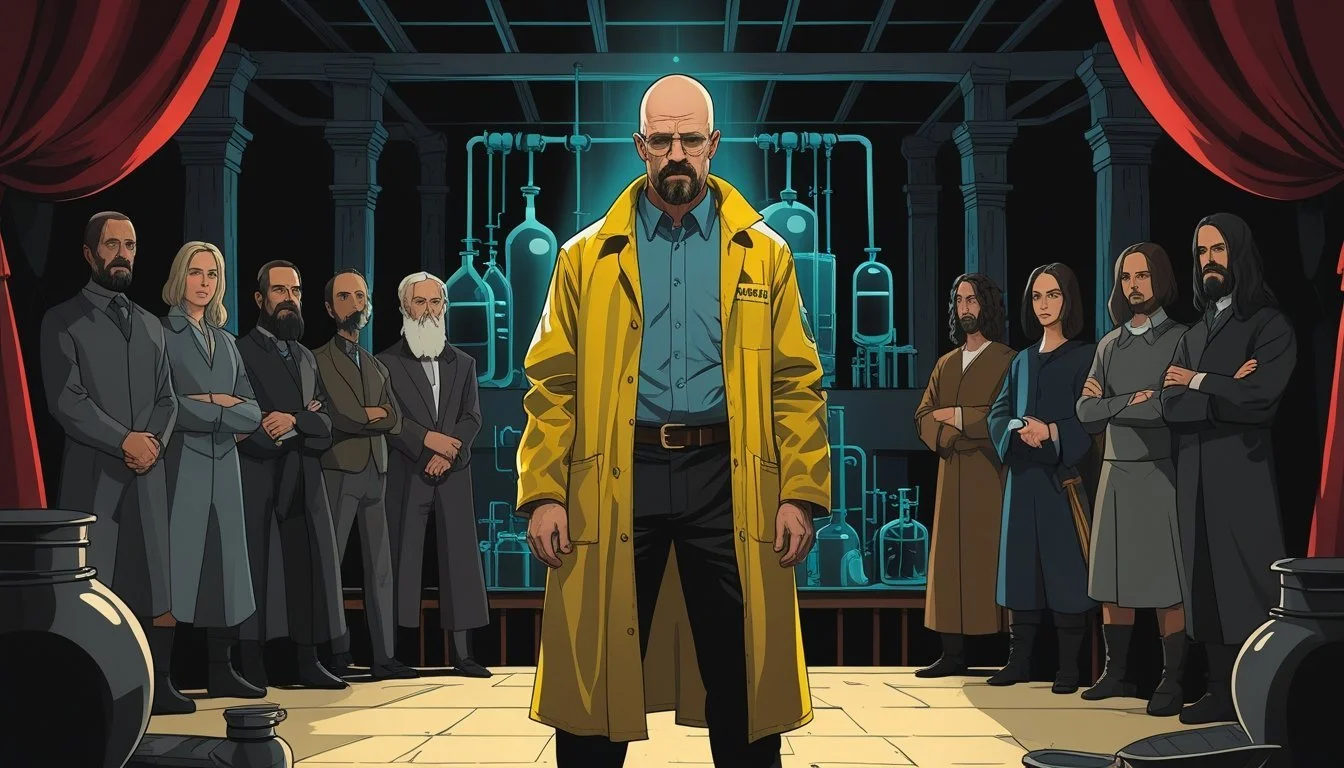
Breaking Bad draws structural and thematic inspiration from Shakespeare’s tragedies, shaping Walter White’s story as a modern exploration of ambition, morality, and downfall. Its narrative mirrors classic tragic forms, offering viewers a familiar yet uniquely contemporary take on fatal flaws and the consequences of unchecked desire.
Shakespeare’s Tragic Structure
Breaking Bad follows a trajectory recognizable from Shakespearean tragedy. The rise and fall of Walter White closely track the tragic arc described in Aristotle’s Poetics and refined by Shakespeare in works like Macbeth and Hamlet.
Shakespeare’s tragedies center on protagonists whose flaws—often pride or ambition—lead to their ruin. Breaking Bad adheres to this form as Walter transforms from an unassuming chemistry teacher to a criminal mastermind, ultimately orchestrating his own demise.
The show also incorporates reversals of fortune and moments of self-recognition (“anagnorisis”). Walt, like Macbeth, experiences a shift from power to vulnerability in the final episodes. The story builds tension through irony and foreshadowing, devices often employed by Shakespeare to heighten emotional impact.
Parallels to Macbeth and Hamlet
Comparisons to Macbeth are particularly strong. Both Macbeth and Walter White begin as seemingly ordinary men who are tempted by ambition. They commit increasingly severe acts to maintain power, rationalizing each decision as necessary. Their journeys are marked by guilt, paranoia, and estrangement from loved ones.
Hamlet contributes another layer—intellectual introspection and existential doubt. Walt, like Hamlet, wrestles with the morality of his choices. His self-justifications and moral dilemmas echo Hamlet’s soliloquies, especially as the consequences of his actions become unavoidable.
While Breaking Bad shares its crime narrative with works like The Great Gatsby and Julius Caesar, its psychological depth and gradual unraveling of character most directly call upon the traditions established in Macbeth and Hamlet.
Universal Themes of Tragedy
Central to both Shakespeare’s plays and Breaking Bad are themes of hubris, power, and the inevitable consequences of personal choice. Walter White is a clear example of a tragic hero whose intelligence and pride drive him toward destruction.
These universal themes resonate because they reflect timeless human struggles. Betrayal, the distortion of ambition, and the conflict between private desires and public actions appear repeatedly, whether in Julius Caesar’s conspiracy or The Great Gatsby’s doomed idealism.
By drawing on these ideas, Breaking Bad extends Shakespearean tragedy into the 21st century. It demonstrates that the appeal and relevance of tragic storytelling remain strong, regardless of era or setting.
Walter White as a Modern Tragic Hero
Walter White’s transformation traces a clear pattern often seen in classic tragedies. His character illustrates the impact of pride, a shifting sense of right and wrong, and the consequences of refusing to recognize his own flaws.
Hubris and the Fatal Flaw
Walt embodies the tragic hero as defined by both Greek and modern standards. His main flaw is hubris—an overblown pride that blinds him to the risks and ethics of his actions.
Initially, Walt’s decisions are driven by desperation, but as he adopts the identity of Heisenberg, his sense of invincibility grows. This confidence leads him to make reckless choices, pushing him deeper into the criminal world.
The belief that he can outsmart anyone feeds his downfall. Walt’s ambition and intellect become the very tools of his undoing.
Hubris Defined
Attribute Example in Walt Overconfidence Expanding his empire Arrogance Undermining rivals Defiance Challenging powerful foes
Moral Compass and Irony
Walt begins with what seems a clear moral compass—he wants to provide for his family after his cancer diagnosis. However, as he rises in power, his actions contradict his stated intentions.
The irony is sharp: in trying to be a protector, he becomes a source of danger. His justifications grow hollow, and each rationalization only serves to highlight his transformation.
Scenes that once show him as a victim later reveal his indifference to collateral damage. Walt’s tragic flaw is not just pride, but the gradual erosion of empathy.
Irony in Walt’s Arc:
Claims to protect family, but endangers them.
Seeks respect, becomes feared.
Justifies crime, loses all innocence.
Downfall and Denial
Walt’s downfall follows the pattern of tragic denial. Even as evidence mounts and loved ones suffer, he refuses to accept the consequences of his choices.
His denial compounds old mistakes, leading to aggressive actions designed to maintain control. He rejects responsibility until the fallout is irreversible.
This refusal to acknowledge the scope of his actions is central to his tragedy. Walt’s story serves as a modern case study of how self-deception and inflexible pride can destroy even the most sympathetic figure.
Key Story Arcs and Character Development
Walter White’s transformation from a high school chemistry teacher to the criminal Heisenberg is shaped by the people around him, the evolving criminal world he enters, and the gradual erosion of his moral boundaries. Each storyline and character interaction contributes directly to his eventual downfall.
The Breaking Bad Narrative Arc
Breaking Bad’s core story arc charts Walter White’s shift from sympathetic protagonist to an antihero whose ambition drives him deeper into crime. The series begins with Walter facing a cancer diagnosis and deciding to cook methamphetamine to secure his family’s financial future. Over time, each decision he makes pulls him further away from his former self.
Distinct narrative beats mark this descent. Early on, Walter’s intentions are framed as noble, but as he encounters success, ego and pride take center stage. His alter ego, Heisenberg, embodies this change, representing his detachment from ordinary morality. The tension escalates with each season, as choices meant for survival become inseparable from personal gain and control.
Key turning points, such as Jane’s overdose and the poisoning of Brock, showcase a man who willingly abandons ethical constraints. In each arc, Walter's transformation is deliberate and methodical, mirroring the structure of classical tragedy.
Supporting Characters: Jesse, Todd, and Jack
Jesse Pinkman stands out as both Walter’s partner and moral counterpoint. While Jesse descends into self-doubt and guilt over their actions, Walter grows colder. Their dynamic serves as a lens through which the audience gauges Walter’s changing character, especially as Walter manipulates and betrays Jesse multiple times.
Todd Alquist and Jack Welker introduce a more ruthless criminal element. Todd’s willingness to kill without hesitation pushes the series into darker territory. Jack and his gang escalate the violence, forcing Walter into increasingly desperate decisions. These supporting characters are not mere foils but active participants whose actions accelerate Walter’s moral decline.
Power struggles and shifting loyalties between these figures underline the central tragedy. Each one, in their own way, draws Walter deeper into criminality, reducing the distance between the man he was and the villain he becomes.
Impact of Family and Morality
Walter’s initial motivation centers on his wife Skyler, son Walt Jr., and newborn Holly. As the story unfolds, Walter’s justifications for violence and deceit increasingly ring hollow. Family conversations and conflicts become battlegrounds for his rationalizations and for his wife’s mounting fear and skepticism.
Morality in Breaking Bad is not presented as a fixed trait but as a sliding scale. Walter’s choices—lying to Skyler, endangering his children, manipulating Hank—reveal shifting moral boundaries. His rationalizations highlight how initial good intentions give way to self-interest and denial.
Table: Key Moments of Moral Decline
Event Moral Impact Jane's Overdose Ignoring a dying person for self-gain Brock's Poisoning Willingness to harm a child for leverage Lies to Family Repeatedly betrays trust and safety
Family and morality interweave throughout Walter’s story, providing the foundation for both his tragic flaws and ultimate downfall.
Anti-Heroes in Contemporary Cinema and Television
Anti-heroes have emerged as some of the most compelling figures in modern storytelling, especially across hit series and films. Their rise reflects changing cultural attitudes toward morality and character complexity in both episodes and feature-length narratives.
Walter White’s Place Among Protagonists
Walter White from AMC's Breaking Bad stands as a defining example of the television anti-hero. Unlike traditional protagonists, Walter’s journey transforms him from a humble chemistry teacher into an infamous drug kingpin.
His descent challenges viewers’ sympathies, forcing them to confront ethical ambiguity. Vince Gilligan, the show's creator, intentionally tests audience loyalty as Walter’s morality erodes.
Walter White’s arc redefines what viewers expect from lead characters. He blurs the boundaries between hero and villain, offering a portrait of ambition, desperation, and transformation rarely matched in mainstream television.
Comparisons: Gotham, The Dark Knight, Hannibal
Walter White’s narrative has clear parallels in contemporary cinema and television. Gotham presents its own array of morally gray characters, such as Jim Gordon and Oswald Cobblepot, who navigate a corrupt city.
In The Dark Knight, Christopher Nolan explores anti-heroism through Batman, whose vigilantism and moral compromises complicate his status as a hero. The Joker and Harvey Dent further cloud the moral landscape, making the film a study in ethical conflict.
NBC’s Hannibal introduces Dr. Hannibal Lecter as a brilliant but monstrous protagonist. Much like Walter White, Hannibal’s complexity draws viewers into dark territory, relying on charm, intelligence, and a constant interplay of good and evil.
Trends in Television Storytelling
The prevalence of anti-heroes marks a major shift in how stories are told on television and in cinema. Traditional heroes often gave way to complex figures torn between virtue and vice, mirroring real-world uncertainties.
Shows like Breaking Bad, Gotham, and Hannibal highlight this trend by placing morally ambiguous characters at the narrative center. Audiences find themselves invested in protagonists who break the law, defy norms, and challenge expectations.
This shift has deepened the emotional engagement and realism of contemporary storytelling. Anti-heroes now dominate critically acclaimed series, driving both viewership and critical acclaim with their nuanced portrayals.
The Lasting Impact and Cultural Relevance
Walter White’s transformation in Breaking Bad continues to shape how audiences engage with television drama. His legacy is visible in public memory, media discussions, and the storytelling of related series.
Memory, Empathy, and Audience Understanding
The memory of Walter White endures due to the complexity of his actions and motives. Viewers recall not just his criminal acts but the justifications and fears that drove him, deepening their empathy and understanding.
His character blurs clear moral lines, encouraging audiences to reflect on how desperation or pride can influence decisions. This fosters nuanced conversations about responsibility and forgiveness.
Audiences revisit Walter’s story through online forums, merchandise, and cultural references. The lasting fascination is partly because his tragic flaws invite ongoing analysis, keeping his story relevant across generations.
Breaking Bad's Influence on Better Call Saul
Better Call Saul, as a prequel and companion to Breaking Bad, expands on its legacy while shaping its own identity. Many narrative techniques, such as non-linear storytelling and deep character development, were popularized by Breaking Bad and adapted in Saul.
Key characters from Breaking Bad, including Saul Goodman, Gus Fring, and Mike Ehrmantraut, receive expanded backstories that enrich understanding. The show inherits themes like moral compromise, consumerism, and ambition.
Better Call Saul also strengthens the interconnectedness of the Breaking Bad universe. By drawing on its predecessor’s tone and structure, Saul proves how spin-offs can deliver both continuity and originality.
Societal Reflections: Race, Class, Gender
Breaking Bad’s story is often read as a commentary on American class systems. Walter White’s choices reflect economic pressures faced by the middle class, and his downfall critiques the pursuit of status and support through illicit means.
The show’s main cast is predominantly white and male, sparking debate about the representation of race and gender. Critics note limited roles for women and people of color, with Skyler White, Gustavo Fring, and Huell Babineaux often discussed as examples.
Race, class, and gender dynamics shape the audience’s interpretation of the series. These aspects fuel ongoing conversations about how prestige television addresses or sidesteps broader social realities.
