
Saul Goodman’s Introduction in Breaking Bad Was a Masterclass in Character Design and Elevated the Series’ Storytelling

Saul Goodman’s introduction in Breaking Bad stands out as a masterclass in character design, setting a high standard for memorable television characters. When Saul first appears in season two’s “Better Call Saul” episode, he isn’t just another lawyer—he’s a striking blend of humor, cunning, and unpredictability that immediately grabs the audience's attention.
Through careful writing and performance, Saul is established as a complex figure whose flashy persona hides a sharp legal intellect and flexible morals. The creators use every detail—from wardrobe to dialogue—to make sure viewers instantly understand what makes Saul Goodman unique within the world of Breaking Bad.
This skillful character design not only added depth to Breaking Bad but also laid the groundwork for Saul's own successful spin-off series. Readers will find that Saul’s debut is more than just an introduction; it’s a showcase of how television can craft unforgettable and impactful characters.
The Context of Saul Goodman’s Debut
Saul Goodman entered Breaking Bad at a critical time for Walter White and Jesse Pinkman. The arrival of a criminal lawyer was driven by specific challenges facing the main characters as they navigated the dangers of Albuquerque’s drug trade.
Setting the Stage: Breaking Bad’s Criminal Underworld
Breaking Bad’s story had grown increasingly complex by the second season. Walter White and Jesse Pinkman were no longer small-time operators; their meth business had caught the attention of both local criminals and federal authorities like the DEA.
The danger had intensified. Walter's partnership with Jesse brought both money and risk, as Albuquerque’s criminal underworld operated under constant threat of surveillance, violence, and betrayal.
Key players included:
Walter White: Teacher-turned-meth-maker seeking control and financial security.
Jesse Pinkman: Walter’s former student and partner, bringing street experience.
DEA: Actively investigating local drug operations, adding constant pressure.
Badger: One of their dealers, whose arrest highlighted vulnerabilities.
As threats mounted, both internal and external forces pushed Walter and Jesse to seek professional help beyond what they could manage alone.
Why a Criminal Lawyer Was Needed
Jesse’s friend Badger was arrested during a meth sale, exposing gaps in the operation’s protection against law enforcement. The risk was no longer theoretical—the DEA was closing in.
They needed someone with knowledge of both the legal system and the criminal world. A typical lawyer wouldn’t be enough; the situation demanded a specialist comfortable with questionable tactics and ethical flexibility.
Saul Goodman was the solution. His introduction offered a lifeline: access to the legal strategies and underworld connections that could keep Walter and Jesse out of prison. His unique blend of legal expertise and moral pragmatism perfectly fit the new demands of their escalating criminal activities.
Analyzing Saul Goodman’s First Appearance
Saul Goodman’s debut in Breaking Bad introduced a vibrant and effective criminal lawyer whose role quickly became essential to Walter White and Jesse Pinkman. His entrance blended humor, visual flair, and sharp performance choices to leave an immediate mark on viewers.
Bob Odenkirk’s Performance Choices
Bob Odenkirk brought Saul Goodman to life with a unique mix of humor, cynicism, and calculated bravado. He balanced the line between comic relief and effective legal advisor, providing lightness amidst the show’s tension.
Odenkirk’s dialogue delivery was quick, witty, and often laced with sarcasm. His body language signaled confidence, often leaning back in his chair or gesturing broadly during client consultations. He projected a relaxed attitude that masked the precise and transactional mind beneath the surface.
The way he spoke to both Walter White and Jesse Pinkman immediately established authority without appearing threatening. Odenkirk’s choices ensured Saul felt both approachable and essential, delivering lines such as, “You don’t need a criminal lawyer. You need a criminal lawyer,” with memorable flair.
Visual Aesthetics and Costuming
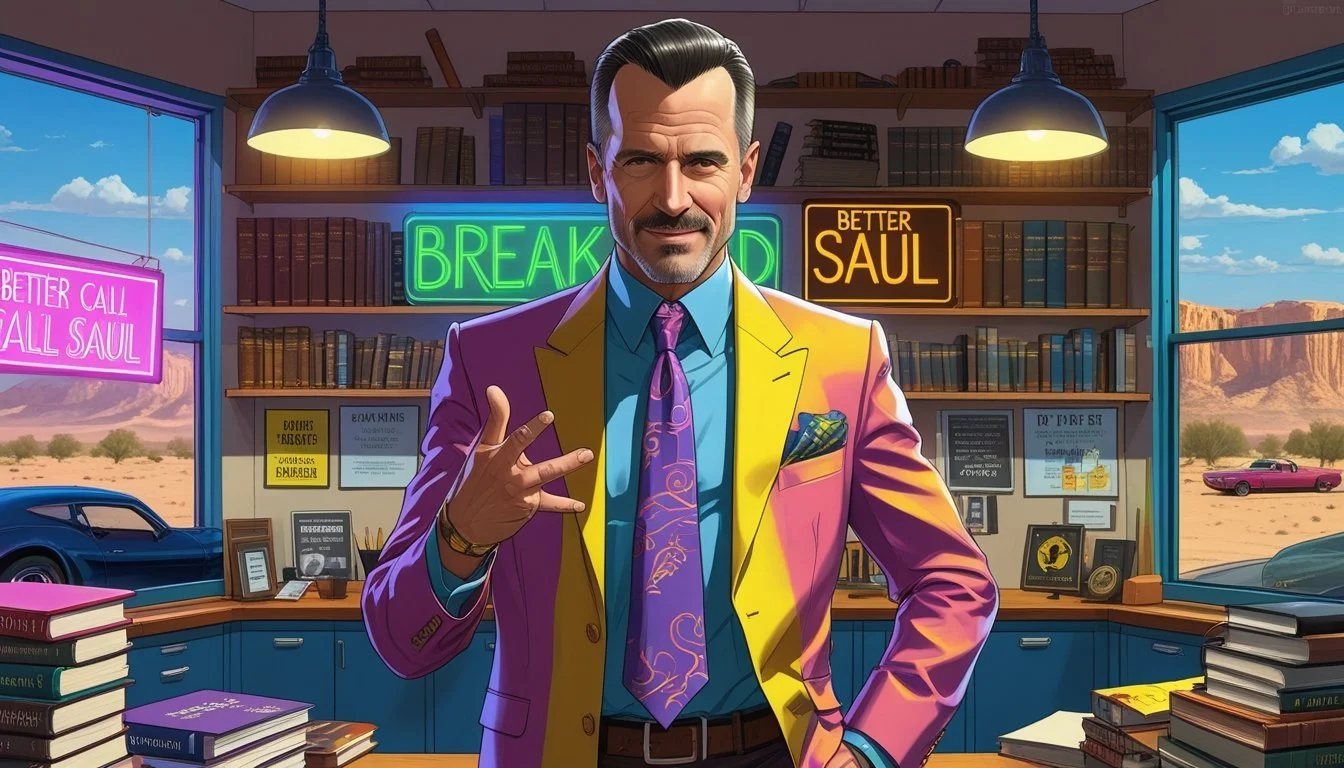
Saul Goodman’s appearance was carefully curated for maximum visual impact. He wore loud, mismatched suits, colorful ties, and a noticeable comb-over that both contrasted and complemented the local Albuquerque setting.
His office, decorated with tacky Constitution wallpaper, statues of liberty, and bold colors, reinforced his flashy and somewhat garish persona. Everything about Saul’s costuming and environment made it obvious that he catered to a specific clientele—those on the edge of legality.
The deliberate visual choices distinguished Saul from other lawyers. Compared to Walter White’s quiet, understated look or Jesse Pinkman’s street style, Saul’s aesthetic signaled a willingness to work in the gray areas of criminal defense.
Memorable Introduction Scene
Saul Goodman’s first scene in Season 2, Episode 8, featured him briskly entering the narrative to defend Badger after his arrest. The episode, named “Better Call Saul,” highlighted Saul’s gut instinct for negotiation and courtroom theatrics.
He quickly assessed the situation and manipulated the legal process, impressing both Walter and Jesse. Saul’s first interaction with them involved clever wordplay and veiled threats, demonstrating his skill as both a lawyer and a fixer.
Odenkirk’s delivery, combined with sharp editing and staging, made the introduction memorable. The blend of humor, legal acumen, and calculated charm ensured that Saul Goodman stood out immediately in the larger Breaking Bad cast.
Constructing an Iconic Persona
Saul Goodman's introduction in Breaking Bad was meticulously crafted to establish a character both memorable and multidimensional. Every detail—from his name and appearance to his marketing tactics—was engineered to stand out and serve story needs beyond comic relief.
Name, Persona, and Brand
The name "Saul Goodman" was selected for its phonetic twist: "s'all good, man." This wordplay signaled his easygoing, approachable character while concealing Jimmy McGill’s real identity.
His loud suits, gaudy office, and colorful mannerisms showcased a lawyer who used branding as armor. Everything about Saul—his business cards, oversized billboard ads, and quirky phrases—was a calculated strategy to create instant recognition on the streets of Albuquerque.
Building a brand gave Saul notoriety far beyond the typical lawyer. He designed his persona to be both a magnet for clients and a shield for criminal activity, leveraging street-level fame as a form of self-advertisement and intimidation.
Comic Relief and Its Functions
Saul often broke the tension with sharp one-liners and quick-witted observations. This use of comic relief served dual purposes: entertaining the audience and disarming tense situations within the criminal underworld.
His humor provided a contrast to Walter White's intensity and to the violence that permeated Breaking Bad. Saul’s comedic timing made crime seem almost routine, lowering the stakes just enough to weave complex schemes without losing the show's momentum.
This approach did not diminish his competence. By making light of dire circumstances, Saul signaled his awareness of the risks inherent in money laundering and criminal law, further cementing his reputation as someone unafraid to laugh in the face of danger.
Advertising and Theatrical Introduction
From his infamous low-budget TV commercials to the giant inflatable Statue of Liberty atop his office, Saul’s advertising methods were deliberately theatrical. His first on-screen appearance, surrounded by the trappings of self-promotion, made an immediate statement about his priorities.
His advertisements were more than mere self-promotion—they invited questionable clients needing creative legal loopholes. Saul designed his public image to attract both the desperate and the criminal, turning his legal practice into a hub for underworld connections.
This relentless marketing not only solidified his client base but also blurred the line between legitimacy and illicit business. Saul’s flair for spectacle was inseparable from his willingness to skirt the law for both clients’ and his own benefit.
Ethics vs. Morality
Saul operated within a complex ethical space. He rarely hesitated to bend the rules or represent clients engaged in criminal activity, but he established his own boundaries—even if those lines shifted constantly.
Money laundering was just one of many services Saul provided, showing a willingness to enable crime as long as it paid well. Still, he often tried to avoid direct violence, revealing a pragmatic, if flexible, moral compass.
The tension between his self-serving choices and the legal profession’s supposed ideals created layered conflicts. Saul balanced profit-driven ethics with occasional moments of conscience, making him unpredictable but never entirely amoral.
Saul Goodman’s Relationships and Influence
Saul Goodman’s introduction marked a turning point in the power dynamics of Breaking Bad. His relationships with both law enforcement and the criminal world allowed him to shape events and manipulate outcomes to his clients’ advantage.
Early Dynamics with Walter White and Jesse Pinkman
Saul’s first meeting with Walter White and Jesse Pinkman quickly established his value as more than just a lawyer. He identified their urgent need for legal protection and offered creative, sometimes dubious, solutions almost immediately.
His methods included orchestrating false alibis and leveraging his knowledge of the criminal justice system. For instance, Saul famously suggested the use of disappearances and money laundering fronts, such as Vamonos Pest Control and car washes.
Walter and Jesse both relied on Saul’s resourcefulness. He not only kept them out of jail but also offered vital connections. This included introducing them to figures like Gus Fring, who would become essential to the duo’s expanding drug empire.
Interactions with the DEA and Law Enforcement
Saul consistently positioned himself as an obstacle and a buffer between his clients and the authorities. He specialized in exploiting legal loopholes and using procedural knowledge to slow down or disrupt DEA investigations.
His activities often put him in close contact with agents probing into Walter White and his associates. Saul’s strategic advice, for example, protected his clients during Hank Schrader’s relentless pursuit of Heisenberg.
Some of his more audacious acts included advising silence during interrogations and orchestrating staged legal threats. Saul also arranged for false witnesses and maintained plausible deniability, complicating efforts by law enforcement to build strong cases against his clients.
Alliances with the Criminal Underworld
Saul’s effectiveness depended heavily on his extensive network within Albuquerque’s criminal underworld. He was linked not only to Walter and Jesse, but to cartel figures, enforcers, and fixers.
He facilitated hiring individuals like Mike Ehrmantraut for security and problem-solving, adding a layer of muscle and expertise to his services. Saul’s cooperation with Gus Fring and Los Pollos Hermanos further expanded his influence and brought new criminal opportunities.
Trusted men like Huell Babineaux and Patrick Kuby carried out tasks ranging from intimidation to theft, always under Saul’s direction. Through connections to figures like Tuco Salamanca, Saul could offer clients options regardless of their legal or ethical standing, further embedding himself as a central player in Albuquerque’s underworld.
Character Origins: Jimmy McGill and Transformation
Jimmy McGill’s path to becoming Saul Goodman is rooted in personal history, education, and the complex dynamics of family and environment. His early life in Cicero, Illinois, formative legal studies, and fraught relationships all contributed to the man seen in Breaking Bad.
From Slippin’ Jimmy to Saul Goodman
Jimmy McGill started out as “Slippin’ Jimmy,” a small-time con artist on the streets of Cicero, Illinois. Alongside his friend Marco, Jimmy specialized in grifts and street hustles. These formative exploits demonstrated his quick wit and sharp improvisational skills.
The persona of Slippin’ Jimmy laid the foundation for his later identity as Saul Goodman. Traits like adaptability and a willingness to bend rules became central to his transformation. By the time he took on the Saul Goodman name, his past cons had already established a moral flexibility that made the shift seem inevitable.
Gene Takavic, Jimmy’s alias after the events of Breaking Bad, is a further transformation, showing the lasting impact of his origin story. Each persona—Slippin’ Jimmy, Saul Goodman, and Gene—reveals a survival instinct shaped by his early experiences.
Education and Law Degree
Jimmy’s formal entry into the legal world began with correspondence courses at the University of American Samoa. Despite skepticism from others, especially his brother Chuck McGill, he persisted and eventually passed the bar exam on his first attempt.
Obtaining his law degree was not just a professional milestone but also an act of self-reinvention. Early on, Jimmy focused on elder law, gaining clients through direct outreach and community charm. He worked for Clifford Main at Davis & Main and became involved in the Sandpiper case, showing both legal ability and a talent for connecting with clients.
Jimmy’s non-traditional education contrasted sharply with the prestigious background of his brother Chuck. This distinction remained a point of tension, influencing both his career trajectory and his decision to craft the Saul Goodman persona.
Family and Early Influences
Family, particularly the relationship with Chuck McGill, played a pivotal role in Jimmy’s transformation. Despite Jimmy’s efforts to legitimize himself, Chuck consistently doubted his abilities and ethics. This lack of support contributed to Jimmy’s feelings of inadequacy and resentment.
Growing up in Cicero, Jimmy learned from personal setbacks and his father’s failed business. These experiences shaped his pragmatic approach to morality. Chuck’s influence was especially significant: his skepticism and rivalry both drove Jimmy to succeed and pushed him toward ethically ambiguous choices.
Encounters with figures like Marco further reinforced Jimmy’s resourcefulness and tendency to test boundaries. Family dynamics, mentorships, and early disappointments combined to create the layered individual who would ultimately become Saul Goodman.
Legacy Across Breaking Bad and Better Call Saul
Saul Goodman became more than just a supporting character, evolving into a figure central to the interconnected stories of two acclaimed series. His journey includes major transformations, deepened by narrative turns and contextual details.
Transition to Gene Takavic
After the events of Breaking Bad, Saul Goodman undergoes a drastic transformation to hide from law enforcement and criminal retaliation. He adopts the new identity of Gene Takavic, living in Omaha, Nebraska as a low-profile Cinnabon manager. The shift from flamboyant lawyer to anxious manager represents the cost of his previous life.
Gene’s life is marked by anonymity, routine, and the constant threat of exposure. He navigates this new world carefully, haunted by memories and regret. Paranoia and isolation become central to his existence.
The Better Call Saul series captures this transition with subtle storytelling techniques, showing Gene’s struggles to adapt and his reluctant acceptance of mundane life. This chapter underscores the profound consequences of Saul’s actions and choices in Breaking Bad.
Impact on Better Call Saul
Better Call Saul explores the backstory of Jimmy McGill’s transformation into Saul Goodman in minute detail. The show details his disbarment, scheming, and how personal failures and relationships—most notably with Kim Wexler—shape his character.
The divorce from Kim highlights Jimmy’s increasing willingness to manipulate situations and people. Their use of spousal privilege and eventual separation play pivotal roles in Saul’s emotional decline.
Supporting characters like Mike Ehrmantraut and Gus Fring, along with recurring legal and criminal dilemmas, further push Jimmy toward his Saul persona. These plotlines give depth to his moral descent and reveal the intricacies behind the mask he wears as Saul Goodman.
Saul’s Place in the Breaking Bad Universe
Saul Goodman’s entry into Breaking Bad instantly left a mark, providing comic relief but also critical narrative connections for Walter White and Jesse Pinkman. His office, mannerisms, and legal trickery symbolized a unique approach to criminal law in Albuquerque.
He served as a vital link between various criminal elements, often facilitating key operations through his legal expertise and connections. Saul’s relationships with characters like Francesca Liddy, his receptionist, and his use of loopholes set him apart.
The character’s creation sparked ongoing discussion about the reality of legal ethics and inspired critical acclaim, culminating in a dedicated spin-off series. His arc bridges both series, demonstrating versatile writing and character design that remained consistent yet surprising.
Creative Vision and Cultural Impact
Saul Goodman's creation and his arrival in Breaking Bad showcased the combined ingenuity of the showrunners and the impactful performance of Bob Odenkirk. The character quickly became emblematic both within the show’s universe and in popular culture, influencing spin-offs and discussions about TV antiheroes.
Vince Gilligan and Peter Gould’s Roles
Vince Gilligan, as the creator of Breaking Bad, worked closely with writer and producer Peter Gould to craft Saul Goodman. They introduced Saul in the show's second season, deliberately designing him as a legal “fixer” who brought both comic relief and complexity.
Gilligan envisioned a lawyer who felt authentic yet unique, drawing on real-world legal archetypes while pushing the character into more original territory. Gould, who wrote Saul’s debut episode “Better Call Saul,” helped ensure the character's personality and language felt sharp, memorable, and fully integrated with the show’s themes.
Together, they shaped Saul as an indispensable part of Walter White’s criminal journey. Their willingness to let Saul’s persona evolve allowed for depth in later seasons and the eventual creation of the prequel series Better Call Saul.
Bob Odenkirk’s Performance Legacy
Bob Odenkirk’s portrayal of Saul Goodman combined a mix of confidence, humor, and subtle emotional range. Known before Breaking Bad for his sketch comedy work on Mr. Show, Odenkirk adapted those comedic instincts to craft a multi-dimensional character who could shift from comic relief to moral ambiguity with ease.
Odenkirk’s performance was recognized by critics, leading to multiple Primetime Emmy Award nominations for his work in the prequel series. He brought nuance to Saul, avoiding caricature while imbuing the role with warmth, desperation, and self-interest.
This legacy contributed to the audience’s investment in Saul’s backstory and justified the exploration of his past in Better Call Saul. Odenkirk’s interpretation elevated the character to one of television’s most memorable lawyers.
Saul Goodman’s Pop Culture Influence
Saul Goodman quickly became a cultural touchstone after his introduction. His signature catchphrase, “Better Call Saul,” has been referenced in advertisements, memes, and parodies, illustrating his significant reach beyond the original series.
The character’s impact led to the development of Better Call Saul, further solidifying his prominence in modern television narrative. The show not only expanded Saul’s backstory but also garnered critical acclaim and a dedicated fanbase, reflecting the strength of his appeal.
Saul symbolizes the morally ambiguous yet relatable antihero. His persona and business ethics have become shorthand for slippery but clever legal maneuvering, regularly cited in discussions about ethical boundaries in both law and media.
