
What Breaking Bad Says About the War on Drugs
Lessons from a Gripping Crime Drama

Breaking Bad offers a stark look at the far-reaching and often destructive impact of the war on drugs on individuals, families, and society. The show’s narrative follows characters drawn into the drug trade, not simply as criminals, but as everyday people deeply affected by economic hardship and systemic pressures. Through Walter White, Jesse Pinkman, and others, Breaking Bad exposes the blurred line between law enforcement and crime, emphasizing the unintended consequences of America’s long-standing drug policies.
Rather than glorifying drug use or crime, the series confronts viewers with the realities faced by those on both sides of the struggle. Drug enforcement efforts, personified by characters like Hank Schrader, are shown as both resolute and deeply flawed, revealing a system that often intensifies the very problems it seeks to solve.
As a cultural commentary, Breaking Bad challenges the audience to reconsider the effectiveness and human cost of the war on drugs, highlighting cycles of violence and trauma that ripple throughout communities. By blending complex characters with a deeply realistic portrayal of their environment, the series invites reflection on the policies that shape real-world outcomes.
Breaking Bad as a Commentary on the War on Drugs
Breaking Bad offers a complex look at America’s war on drugs, using its characters and storylines to highlight the real-world consequences of drug policy. Through clear depictions of law enforcement, policy challenges, morality, and systemic flaws, the series raises important questions about the effectiveness and impact of current approaches.
Depiction of Law Enforcement
Breaking Bad gives significant screen time to law enforcement, particularly the DEA, through the character of Hank Schrader. Hank is portrayed as dedicated and competent, often using all resources at his disposal to investigate and respond to the methamphetamine trade.
Despite his professionalism, the show reveals the limitations of DEA strategies. Surveillance, undercover work, and informants are central tools, yet major players like Walter White operate for years without detection.
This portrayal suggests that, even with strong efforts, law enforcement is often reactive rather than preventive. The show avoids glamorizing police work and instead illustrates its personal costs—Hank develops PTSD and struggles with frustration and bureaucracy.
Challenges of Drug Enforcement Policy
The series demonstrates the difficulties of enforcing drug policy in a society where illegal substances remain in high demand. By showing large criminal enterprises and the violence they breed, Breaking Bad illustrates unintended side effects of drug prohibition.
Meth prices remain high due to risk and criminalization, which in turn attracts individuals looking for financial escape, like Walter White. The cycle of enforcement and innovation in criminal networks creates a “cat and mouse” game, with law enforcement and criminals repeatedly adapting to each other.
In key scenes, Breaking Bad shows how efforts to stem drug production can lead to more secretive and dangerous operations, pushing individuals deeper into criminality rather than deterring them.
Morality and the Law
Breaking Bad frequently blurs the line between morality and legality. Walter White’s transformation from a struggling chemistry teacher into a drug manufacturer is driven in part by systemic gaps—such as unaffordable health care and limited economic opportunity.
The series presents the war on drugs as a context in which ordinary people may make illegal choices under duress. Characters repeatedly confront questions about right and wrong that are complicated by personal need, loyalty, and circumstance.
By showing characters justify their actions as responses to systemic failures, the show questions whether laws always coincide with moral behavior. This highlights tensions between the letter of the law and the pressures of real life.
Status Quo and Systemic Issues
Breaking Bad underlines the persistence of the status quo in the war on drugs. Despite the massive efforts of law enforcement and frequent arrests, drug distribution systems continue to thrive and evolve.
Systemic issues portrayed include economic inequality, lack of access to health care, and gaps in the social safety net. These pressures drive some characters into the drug trade as a means of survival or advancement.
The series suggests that simply targeting individuals does little to address broader structural conditions. Through Walter, Jesse, and others, Breaking Bad emphasizes how deep-rooted societal problems perpetuate cycles of crime and addiction, casting doubt on whether current drug policies address root causes.
How Breaking Bad Reinvents Drug War Storytelling
Breaking Bad changes the way television explores the War on Drugs by diving into the personal consequences, inviting viewers to see the humanity and desperation behind illegal actions. The show’s approach stands apart from predecessors on major networks like HBO and Showtime.
Shifting Focus From Cops to Criminals
Traditional drug war dramas such as NBC’s Law & Order and even HBO’s The Wire often center on police and investigation. Breaking Bad, created by Vince Gilligan for AMC, turns the lens away from law enforcement and instead follows chemistry teacher Walter White as he transforms into a drug kingpin.
This shift of perspective provides a ground-level view of the drug trade. The show explores the lives of dealers, manufacturers, and those caught in the system, highlighting how choices are shaped by circumstance rather than inherent criminality.
By focusing on Walter and his partner Jesse Pinkman, Breaking Bad humanizes the very people the War on Drugs targets. Viewers see their motivations, personal losses, and justifications, painting a more nuanced picture that complicates simple “good versus evil” narratives.
Complex Motivations of Main Characters
Walter White’s descent from family man to criminal kingpin is driven by his cancer diagnosis and mounting medical bills, not by greed or malice from the outset. AMC’s Breaking Bad spends significant time showing how health care costs, pride, and fear push ordinary people into extraordinary circumstances.
Jesse Pinkman, meanwhile, grapples with addiction, trauma, and loyalty. His decisions reflect a constant struggle between survival and morality. These characters are not stereotypes; instead, their actions are shaped by personal history, the pressures of the drug trade, and interactions with law enforcement.
This approach distinguishes Breaking Bad from many other crime shows, which often present criminals’ motivations as flat or singular. Here, the “bad guys” are complex, with needs and doubts that drive choices leading to tragic results.
Comparison With The Wire and Weeds
Breaking Bad shares thematic ground with HBO’s The Wire and Showtime’s Weeds. However, each show approaches the drug war from unique angles. The Wire examines a broad spectrum of Baltimore society—from police to politicians to drug organizations—offering a systemic critique of institutions.
Weeds, on the other hand, uses humor and suburban settings to highlight the normalization of drug culture in middle-class America. Its protagonist Nancy Botwin does not descend into violence and paranoia as Walter White does, but both shows explore how ordinary lives intersect with illegal economies.
What sets Breaking Bad apart is its intense focus on the individual transformation of a single main character into a kingpin, showing not only the financial but emotional and ethical costs at every stage. This sharper character study, paired with a narrower, more personal scope, allows Breaking Bad to reinvent how television tells stories about the War on Drugs.
Character Studies: The Faces of Drug Culture
Breaking Bad introduces viewers to a range of characters whose lives are deeply shaped by the realities of the drug trade. Each major figure’s experience provides a different perspective on the motivations, consequences, and complexities found within drug culture.
Walter White and the Birth of Heisenberg
Walter White, portrayed by Bryan Cranston, begins as a high school chemistry teacher struggling financially and facing a terminal cancer diagnosis. His decision to manufacture methamphetamine is initially justified as a way to support his family. Over time, Walter transforms into the ruthless alter ego "Heisenberg," driven by pride, power, and a need for control.
The show charts Walter’s evolution as he sets aside morality and legality in pursuit of success within the criminal underworld. His journey demonstrates how individuals can become deeply entangled in the drug economy, not just for survival, but for ego and influence. Walter’s story exposes the unintended consequences—both personal and societal—of the war on drugs and strict prohibition policies.
Jesse Pinkman’s Struggle
Jesse Pinkman serves as both Walter’s partner and a casualty of the drug world. Once a small-time meth manufacturer and user, Jesse represents those caught in cycles of addiction, crime, and marginalization. His background in drugs predates his partnership with Walter, highlighting how generational and social factors contribute to involvement in illicit activities.
Throughout the series, Jesse’s struggles with substance abuse, trauma, and moral conflict are central. He experiences loss, manipulation, and criminal justice intervention, leading viewers to reflect on the often-overlooked human costs of drug policy and enforcement. The character’s journey is marked by attempts to escape the life he helped build, illustrating how difficult real change can be.
Gus Fring: The Corporate Drug Kingpin
Gus Fring operates as a highly successful and disciplined drug lord, managing an empire under the cover of a legitimate business—Los Pollos Hermanos. Unlike Walter or Jesse, Gus uses calculated restraint, organization, and corporate structure to control his operation.
Gus demonstrates how large-scale trafficking can operate efficiently, often evading law enforcement for years. His character reveals the sophisticated levels at which drug networks can exist, challenging simple narratives that drug dealers are always disorganized or violent. Gus’s professional demeanor masks his ruthlessness, underlining the market forces and business strategies that fuel the drug trade beneath the surface.
Skyler White and Family Dynamics
Skyler White, Walter’s wife, becomes deeply entangled in the consequences of Walter’s choices. Initially unaware, Skyler eventually manages the family’s finances and helps launder money, highlighting the ripple effects of the drug trade on loved ones.
Her perspective is critical for understanding how drug crimes extend far beyond producers and dealers. Skyler’s actions, often taken to protect her children and ensure stability, underscore the difficult choices families face when legal and moral boundaries are crossed. Her internal conflict and shifting roles reveal how drug-related decisions can fracture family trust and personal identity, even among those not directly involved in criminal activity.
The Science of Meth: Chemistry, Knowledge, and Consequences
The transformation of chemistry from classroom instruction to illicit drug synthesis is a central element of Breaking Bad. The intersection of scientific expertise, secretive methamphetamine manufacturing, and the ethical issues of applying such knowledge in illegal contexts shapes both the story and real-world discussions.
Chemistry Teacher to Meth Manufacturer
Walter White’s background as a high school chemistry teacher provides the scientific expertise required for methamphetamine synthesis. His familiarity with chemical reactions and laboratory safety is repurposed for unauthorized drug manufacturing. This shift demonstrates how scientific knowledge can be redirected from educational pursuits to illegal activities.
Walter’s meticulous understanding of chemical principles allows him to create a meth product that is higher in purity than what is commonly produced. He applies skills such as controlled heating, precise measurements, and handling of dangerous reagents. Through this, the show illustrates how even advanced and beneficial scientific training can be used outside of intended legal or ethical boundaries.
Realities of Methamphetamine Production
Methamphetamine, or N-methylamphetamine, is a potent stimulant. In Breaking Bad, the production process is depicted with a level of realism that emphasizes the dangers involved. Modern meth labs typically operate without adherence to health standards, using makeshift equipment and hazardous chemicals.
Chemicals including pseudoephedrine, red phosphorus, and anhydrous ammonia are used in methods that are both risky and environmentally destructive. The accurate portrayal of these processes in the show is due in part to scientific consulting from professionals like chemistry professor Donna Nelson. However, crucial steps and details are omitted in the series to avoid providing a blueprint for illegal drug production.
Ethical Implications of Scientific Knowledge
The ability to produce methamphetamine highlights ethical questions about the possession and use of specialized knowledge. Scientists and educators possess skills that can be used for societal benefit or harm, depending on intent and moral choices. The repurposing of chemistry for illicit gain in Breaking Bad underscores the responsibilities that come with expertise.
This dual nature of knowledge calls attention to the role that ethics play in scientific practice. While knowledge in itself is neutral, its application carries consequences. The show encourages viewers to consider how personal and societal values intersect with access to scientific techniques and information.
Law Enforcement and Legal Issues Portrayed in the Series
Breaking Bad presents a complex look at American law enforcement and the legal system’s role in the War on Drugs. The series highlights federal and local conflicts, the unique challenges faced by DEA agents, and ethical dilemmas within attorney-client relationships.
Federal Law and Local Enforcement
The series often highlights the tension between federal drug laws and the realities of local police work. Federal agencies, primarily the DEA, pursue methamphetamine production aggressively, but local law enforcement sometimes appears overwhelmed or under-resourced.
Breaking Bad uses characters like Hank Schrader to illustrate the considerable pressure and bureaucratic challenges that federal agents face. His investigations involve jurisdictional disputes with local police and require coordination across multiple agencies.
A central theme is the gap between policy ambitions and on-the-ground realities. The show demonstrates that large-scale federal initiatives frequently leave local agencies struggling to manage fallout, such as rising violence or overburdened court systems.
Police Practices and DEA Agents
Breaking Bad depicts day-to-day police work through flawed but determined officers and agents. Hank, a DEA agent, frequently operates in dangerous situations with limited backup. His reliance on informants, surveillance, and undercover operations shows the practical limits of law enforcement in dismantling drug cartels.
The show emphasizes the risks agents face; Hank is subjected to violence and trauma because of his investigative work. Although police use advanced technology and legal procedures, the series shows that criminal organizations often adapt faster, outpacing law enforcement efforts.
Ethical dilemmas arise for officers and agents, such as choosing when to bend the rules to advance an investigation, highlighting the push and pull between justice and legal procedure.
Attorney-Client Communications and Saul Goodman
Attorney-client relationships in Breaking Bad are epitomized by Saul Goodman. Saul maneuvers legal gray areas, offering clients both criminal defense and practical strategies for evading law enforcement.
He exploits loopholes in attorney-client privilege and attorney ethics, which raises questions about the boundaries of legal advocacy. Saul’s role extends beyond advice; he orchestrates money laundering schemes and negotiations between criminals, blurring legal and ethical lines.
The series uses Saul's actions to underscore the ways in which lawyers can both challenge and manipulate the legal system. His character embodies a flexible approach to law, reflecting real-world concerns about attorney conduct in high-stakes criminal cases.
Business, Capitalism, and the Drug Economy
Breaking Bad explores the drug trade as a complex business, showing how capitalist motives drive decisions and structure conflicts. The series examines financial methods, power networks, and the pursuit of status through illegal enterprise.
The Drug Business as Capitalist Venture
Walter White’s transformation highlights the parallels between running a meth operation and managing a legitimate business. He applies market analysis, risk assessment, and quality control, aiming to outcompete rival drug dealers through superior product and distribution.
Opportunities in the illicit market are dictated by basic economic principles. Supply and demand shape pricing, competition fuels turf wars, and innovation—like Walter’s chemically pure blue meth—brings disruptive advantages. Drug kingpins, like Gus Fring, run streamlined organizations with clear hierarchies, mirroring legal corporate structures.
Key features include:
Legitimate Business Drug Operation in Breaking Bad Product Innovation High-purity blue meth Market Competition Rival cartels and dealers Supply Chain Secure ingredient acquisition Expansion New territories and distribution
The show underscores that the illegal drug economy functions as a shadow marketplace governed by similar capitalist dynamics as above-ground industries.
Money Laundering and Financial Strategies
Securing profits from illegal activity requires effective laundering, and Breaking Bad shows this through Saul Goodman’s schemes and the use of front businesses like the car wash. Money is funneled and disguised to evade law enforcement scrutiny.
Characters use a variety of methods to legitimize drug money. Skyler White orchestrates the car wash’s finances, carefully blending cash flows, manipulating invoices, and inventing expenses. Even small missteps, like a cash discrepancy, risk exposure.
The complexity increases as operations grow—stacks of cash present logistical challenges that legal enterprises rarely face. The series frequently emphasizes the tension between rapid profit generation and the slow, meticulous process of financial cleansing. This highlights the critical role of strategy in sustaining illegal ventures.
The Role of Status and Power
Power dynamics shape every aspect of the drug economy depicted in Breaking Bad. Characters pursue not only wealth but also dominance, reputation, and fear, driving them into dangerous conflicts.
Walter White’s rise from chemistry teacher to kingpin is driven partly by a desire for recognition within the drug business. Control of supply, distribution, and personnel becomes a measure of status. Rivals like Hector Salamanca and Gus Fring hold authority through networks of loyalty, violence, and negotiation.
Achievements are marked by both financial accumulation and displays of influence. Status is established with acts of ruthlessness or tactical decision-making, consolidating one’s position at the top of the hierarchy. The relentless pursuit of power exposes divisions, alliances, and shifting loyalties throughout every level of the illegal enterprise.
The New Mexico Setting: Social and Legal Context

The choice of New Mexico as the main setting for Breaking Bad is not just visual but deeply connected to the state's actual legal and social environment. Issues like regional drug policy, local academic analysis, and real community repercussions are central to understanding why the story unfolds the way it does.
Drug Policy in New Mexico
New Mexico has long faced substantial challenges with drug trafficking and overdose deaths due to its proximity to the Mexican border and rural geography. Its drug policy has sought a balance between punitive measures and harm reduction efforts. The state was one of the earliest to implement syringe exchange programs and has expanded access to naloxone, reflecting a pragmatic approach to opioid overdoses.
Despite these initiatives, criminal penalties for drug offenses remain significant, contributing to a cycle of incarceration. The show’s depiction of law enforcement highlights these tensions, as police and federal agents operate in a region marked by both innovation and severe consequences in drug policy. This environment influences both the choices characters make and the risks they face.
Implications in the New Mexico Law Review
Legal scholars have paid careful attention to the world of Breaking Bad, particularly through publications like the New Mexico Law Review (NMLR). In special issues, such as those involving contributors like Matthew Zidovsky, scholars have analyzed how the legal system would realistically respond to characters such as Walter White and Skyler White.
Topics frequently explored in NMLR articles include the effectiveness of sentencing laws, the collateral damage of the war on drugs, and the portrayal of plea deals. Contributors use the show as a touchpoint to debate how legislation and enforcement in New Mexico match or diverge from the show's dramatization. These legal discussions help clarify the boundaries between fiction and real state law.
Community Impact
Breaking Bad captures several realities faced by New Mexico communities, such as the role of organized crime and the impact of drug abuse. The show’s setting reflects actual socioeconomic concerns—ranging from job scarcity to strained public health resources—that can make illegal enterprise seem attractive.
Local residents depicted in the series grapple with fear, mistrust, and the repercussions of violence. These portrayals are grounded in fact, as real communities in New Mexico have felt the effects of the drug trade, both in increased law enforcement activity and evolving public attitudes toward addiction. The visibility of Albuquerque’s neighborhoods highlights how the war on drugs touches individual families and entire communities.
Cultural Impact and Legacy of Breaking Bad

Breaking Bad, created by Vince Gilligan and aired on AMC, left a lasting imprint on television, sparking national debate on the War on Drugs and shaping pop culture. Its influence extends from critical acclaim and devoted audiences to major spinoffs and ongoing public discussions.
Audience Reactions and Critical Recognition
Breaking Bad received significant attention from viewers and critics starting with its first season and gaining momentum through season 2 and beyond.
The portrayal of Walter White, played by Bryan Cranston, generated discussions about morality, crime, and personal responsibility. The series routinely earned high ratings, especially during its final season and finale.
The show won numerous awards, including 16 Primetime Emmy Awards. Bryan Cranston’s performance became iconic, advancing his career and cementing him as a leading actor. Breaking Bad’s storytelling and character arcs are consistently referenced as standards for televised drama.
Adaptations and Spinoffs
The legacy of Breaking Bad includes successful adaptations, most notably the spinoff series Better Call Saul. This series delves into Saul Goodman’s backstory and expands the narrative universe, earning both critical and commercial success.
El Camino: A Breaking Bad Movie further explores Jesse Pinkman’s fate after the original’s ending.
Beyond these direct continuations, Breaking Bad’s influence can be seen in other crime dramas that adopt similar narrative techniques and character complexity. References and parodies of the show have appeared in media events, including NFL broadcasts, underlining its cultural reach.
Influence on Drug War Discourse
Breaking Bad fueled conversation about American drug policy and the realities of the War on Drugs. By dramatizing the effects of illegal methamphetamine production and distribution, the show illustrated both the incentive structures and the damage of prohibition-era drug enforcement.
Social commentators and policymakers referenced the series in debates, examining its depiction of law enforcement, cartel violence, and urban drug economies. Breaking Bad is now often cited in academic analysis as a pop culture benchmark for critiquing U.S. drug policy, emphasizing unintended consequences and the blurred lines between good and evil.
Comparative Analysis: Breaking Bad Versus Other Crime Dramas
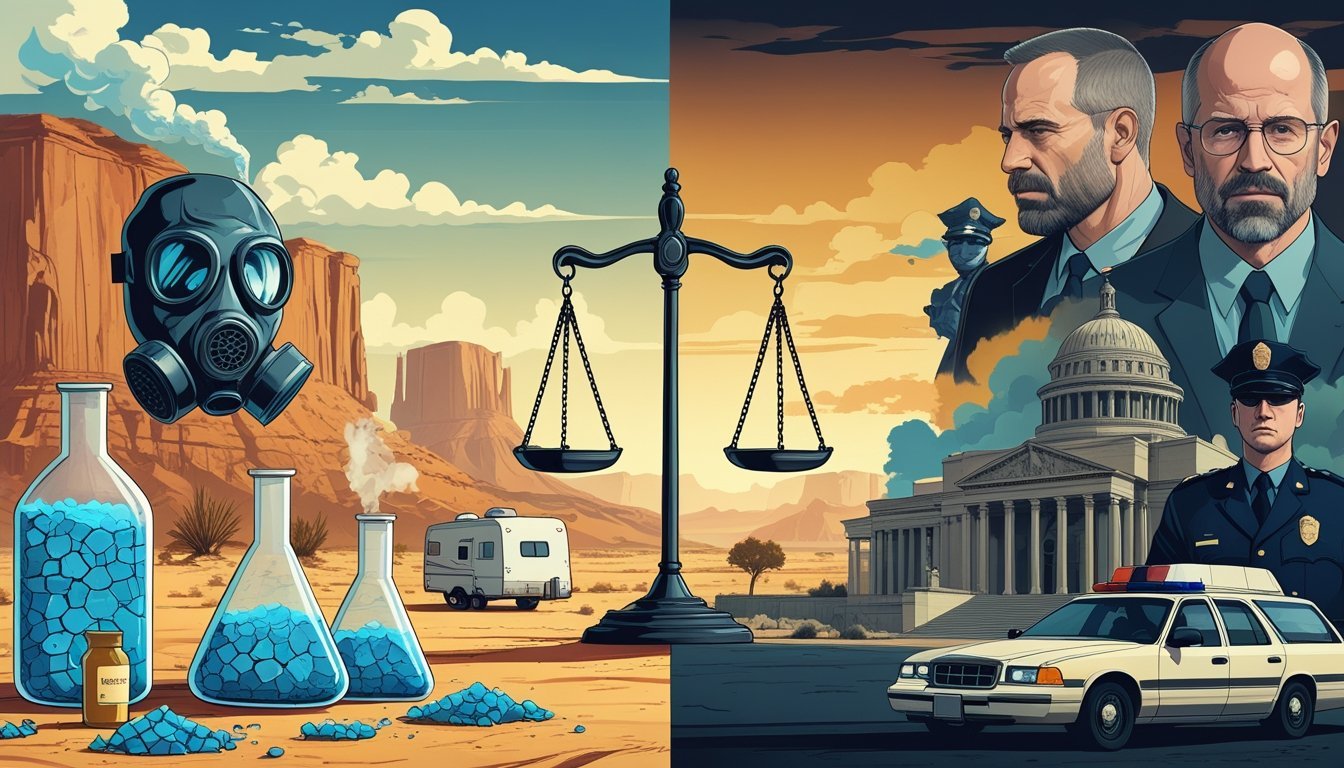
Breaking Bad takes a distinct approach to the crime drama genre, exploring both the personal and systemic impacts of the drug trade. Its narrative style, character development, and thematic influences create notable contrasts with several contemporary series.
Contrasts with The Wire and Weeds
Breaking Bad and The Wire both address the realities of the drug trade but differ in focus. Breaking Bad centers on Walter White’s personal transformation and the chemistry-driven meth business in Albuquerque. The Wire, produced by HBO, offers a broader exploration, examining the distribution chain, law enforcement, and political systems in Baltimore.
The Wire employs a multi-layered narrative, showing how institutional failures sustain the drug market. It critiques systemic issues, involving characters from various social spheres. In comparison, Breaking Bad personalizes the consequences of the War on Drugs by focusing on one family’s descent.
Weeds takes yet another angle. It adopts a darkly comedic approach by following a suburban mother who enters the marijuana trade. Unlike Breaking Bad’s intense dramatics or The Wire’s realism, Weeds uses satire to explore the normalization of drug dealing in American suburbia.
Show Setting Drug Focus Narrative Style Breaking Bad Albuquerque Methamphetamine Personal, intense The Wire Baltimore (HBO) Multiple drugs Systemic, multi-layered Weeds Suburbia Marijuana Dark comedy, satirical
Western Influences on the Narrative
Breaking Bad incorporates Western elements in its storytelling, setting, and character arcs. The show often frames Albuquerque’s landscape with vast deserts and dusty highways, evoking classic Western iconography.
Key characters, especially Walter White, are constructed in the mold of the antihero archetype found in Westerns. Conflict often unfolds in tense standoffs, reminiscent of classic showdowns in traditional Western films. Costuming and music further reinforce these influences, lending a sense of lawlessness and frontier justice.
These Western motifs are rarely present in other crime dramas such as The Wire or Weeds. The Wire maintains an urban realism, rooted in contemporary city life. Weeds focuses on suburban sprawl with almost no reference to Western traditions. Thus, Breaking Bad stands apart by merging genre tropes with modern crime storytelling, creating a unique aesthetic and thematic resonance.
