
History's Most Disturbing Serial Killers: 10 True Crime Cases That Changed Forensic Psychology
Serial killers have fascinated and horrified society for decades, with their gruesome acts challenging our understanding of human nature. From the haunting case of Anatoly Moskvin, who transformed corpses into dolls in his Russian home, to Leonarda Cianciulli's macabre practice of turning victims into soap and cakes, these individuals represent the darkest aspects of humanity. Each case reveals complex pathologies that drive seemingly ordinary people to commit unthinkable atrocities.
The motives behind these crimes often stem from trauma, mental illness, or twisted logic that makes sense only to the perpetrator. Whether it's Ed Gein's obsession with crafting furniture from human remains or Juana Barraza targeting elderly women across Mexico City, these killers developed signature methods that eventually led to their capture. The psychological patterns revealed through these cases continue to inform criminal investigations and our understanding of extreme human behavior.
Key Takeaways
Serial killers often transform their victims' remains into objects, revealing deep psychological disturbances beyond the act of murder itself.
Many notorious murderers maintained ordinary public personas while secretly committing horrific crimes over extended periods.
Childhood trauma and mental illness frequently appear as contributing factors in the development of serial killers' violent behaviors.
Anatoly Moskvin: The Macabre Doll Maker
Life and Background of Anatoly Moskvin
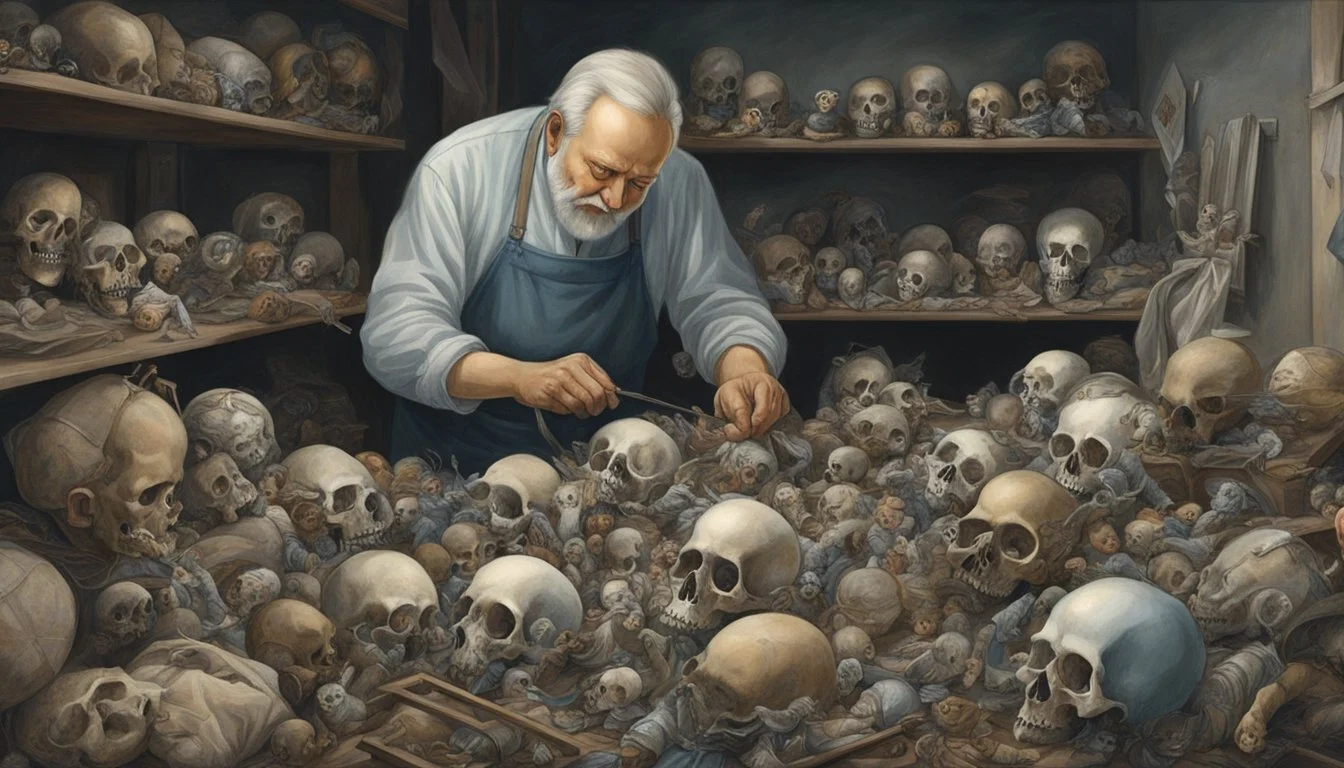
Anatoly Moskvin was a 53-year-old Russian historian and linguist with an extensive educational background. He worked as a translator for military intelligence during the Soviet era before transitioning to writing history books after its collapse. Moskvin possessed deep knowledge of biology and developed an unusual fascination with cemeteries that would later manifest in horrifying ways.
His intellectual capabilities were never in question - he was well-educated and could speak multiple languages. These academic achievements made his later crimes all the more shocking to those who knew him professionally.
Grave Desecration and Mummification Techniques
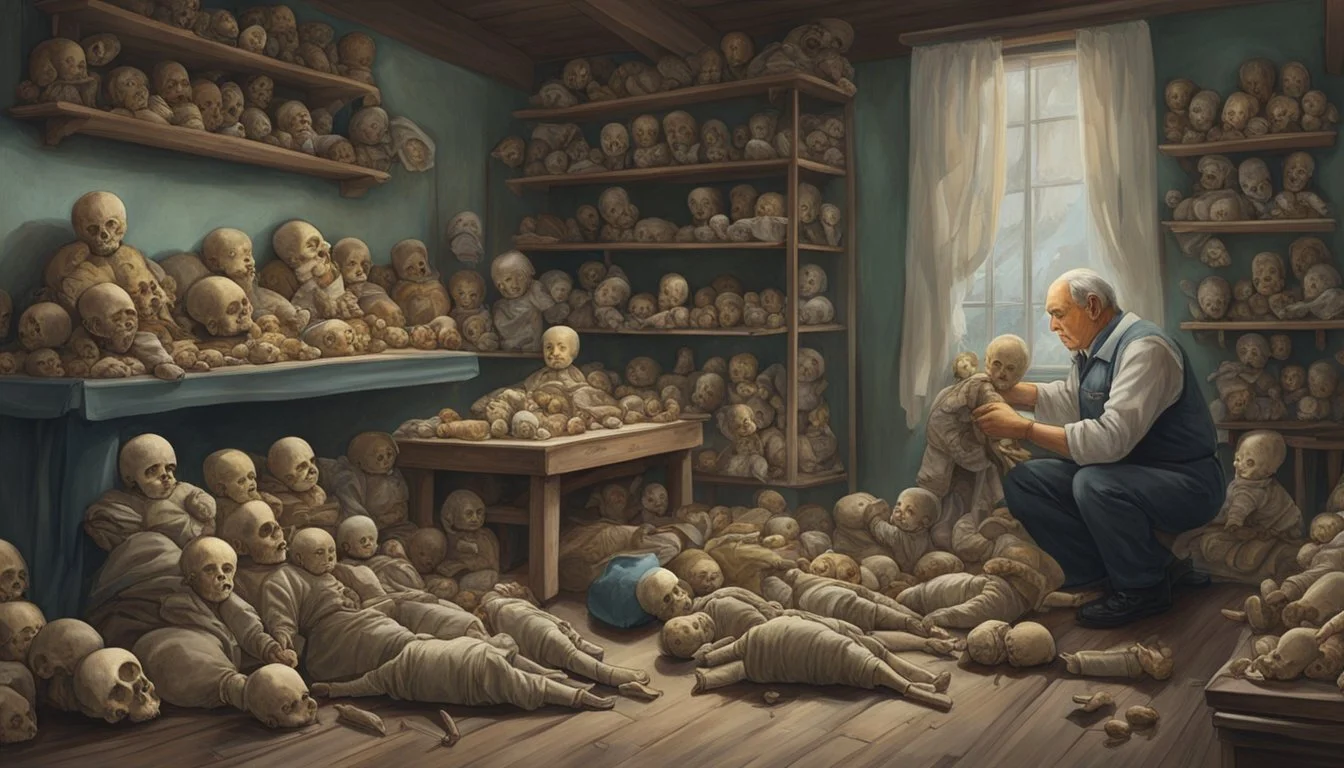
Between the late 2000s and 2011, Moskvin exhumed the bodies of at least 29 young girls from their graves. He brought these remains to his home where he transformed them into macabre dolls through an elaborate mummification process. Moskvin dressed the corpses in clothing, applied makeup to their faces, and covered them with masks to preserve their appearance.
He showed disturbing dedication to his "collection," even celebrating the birthdays of the deceased girls with parties. When confronted about his actions, Moskvin displayed no remorse, offering the chilling justification: "You left them in the cold, I took them home to keep them warm."
Cohabitation With Unsuspecting Parents
One of the most astonishing aspects of this case was Moskvin's living situation. He shared his home with his elderly parents while maintaining his collection of mummified remains. Despite the presence of numerous life-sized "dolls" throughout their residence, his parents claimed complete ignorance of their true nature.
They told authorities they believed these figures were simply part of their son's unusual hobby. This remarkable lack of awareness allowed Moskvin to continue his activities for years without interference from those closest to him.
Arrest and Psychiatric Confinement
Moskvin's crimes came to light in 2011 when authorities discovered his grisly collection. He subsequently confessed to 44 counts of grave desecration and was taken into custody. Rather than facing standard criminal proceedings, Moskvin was diagnosed with schizophrenia and committed to a psychiatric institution.
As recently as 2020, there were discussions about potentially releasing him based on claims his schizophrenia had been successfully treated. However, the judge overturned this appeal, and Moskvin remains institutionalized. The shocking nature of his crimes continues to disturb those familiar with the case, making it one of Russia's most unsettling criminal matters.
Leonarda Cianciulli: The Soap Maker of Correggio
Early Life and Family Struggles
Leonarda Cianciulli was born in 1894 in Italy and later established a small soap shop in the town of Correggio during the 1930s. Her life was marked by numerous hardships, including a brief imprisonment for fraud and the destruction of her home in an earthquake. Her marriage created ongoing tension with her disapproving parents, adding further strain to her daily existence.
Cianciulli's most profound struggle centered around fertility and childbearing. Of her remarkable seventeen pregnancies, only four children survived to adulthood. Three ended in miscarriage, while ten of her children died during their early years, causing immense grief and anxiety about the welfare of her remaining children.
Mysticism and Prophetic Beliefs
Superstition played a significant role in Cianciulli's life, particularly as she faced repeated loss and tragedy. She developed a deep interest in mystical practices including:
Fortune telling
Palm reading
Tarot cards
These interests, which began in her childhood, intensified as she sought explanations and control over her difficult circumstances. A pivotal moment occurred when another fortune teller delivered a devastating prophecy that her four surviving children would also die. This same mystic suggested a terrible solution: human sacrifice would be necessary to protect her remaining family.
Desperate Measures for Maternal Protection
Cianciulli didn't immediately act on the fortune teller's advice, but in 1939, her son's announcement that he planned to join the military triggered her murderous response. Convinced that sacrifices were required to ensure her children's safety, she began luring women to her shop.
Her victims were targeted through manipulation:
Promises to tell their fortunes
Offers to help find husbands
Presenting herself as someone who could assist with their problems
Cianciulli's motivation stemmed from maternal fear rather than hatred. In her distorted thinking, these murders served as protective rituals to safeguard her surviving children—sacrifices she believed necessary after years of repeated loss.
Methods and Disposal Techniques
Cianciulli's approach to murder involved careful planning and disturbing disposal methods. She would first gain her victims' trust before drugging them with wine laced with sedatives. Once unconscious, she killed each woman with an axe.
The disposal of bodies revealed her truly disturbing nature:
Stage Method 1 Dismemberment of victim's body 2 Boiling remains in caustic soda 3 Processing fat into soap 4 Creating edible products from remains
The soap made from her victims' body fat was distributed to neighbors, friends, and paying customers who remained oblivious to its origins. Most horrifying, she used some of the human fat to make cakes, which she consumed herself.
Her killing spree ended after three victims when a witness spotted the final victim entering Cianciulli's shop but never leaving. When police investigated, she readily confessed to her crimes, bringing an end to one of Italy's most macabre murder cases.
Moroccan Homicide: Culinary Deception for Laborers
A Crime Rooted in Betrayal
In 2018, a Moroccan woman committed a horrific act of violence against her partner of seven years. Their relationship deteriorated when she discovered his plans to marry another woman from Morocco. This betrayal triggered an extreme emotional response, pushing her beyond rational thought.
The woman, whose identity remains protected in court documents, felt discarded and humiliated. Her mounting sense of rejection culminated in violence against the man who had shared her life for nearly a decade.
Preparing the Remains
Following the murder, the woman engaged in disturbing post-mortem activities that shocked investigators. She dismembered her boyfriend's body and processed the remains using kitchen appliances. Using a standard household blender, she ground portions of his flesh into small pieces.
The woman combined these human remains with rice and vegetables to create a traditional Moroccan dish. The preparation appeared methodical and deliberate rather than frenzied, suggesting a calculated response rather than mere impulse.

Uninformed Participants
The woman's actions extended beyond the murder itself to include unwitting third parties. She took the prepared dish containing human remains to a nearby construction site where Pakistani laborers were working. Without revealing the true nature of the food, she served it to these workers and observed as they consumed it.
The construction workers had no knowledge of what they were eating. Their involvement as unwitting cannibals added another layer of horror to an already disturbing crime. These innocent bystanders became entangled in a gruesome scenario without their consent or awareness.
Discovery and Admission
The crime remained undiscovered until the victim's brother began searching for his missing sibling. During his investigation, he visited the woman's residence where he made a disturbing discovery: a human tooth in a blender. This grim finding prompted him to contact authorities immediately.
Police conducted forensic testing on the tooth and confirmed it belonged to the missing man. When confronted with this evidence, the woman broke down and provided a full confession detailing her actions. Medical professionals determined she had experienced a severe mental health crisis.
The court ordered her commitment to a psychiatric facility rather than a traditional prison. Mental health experts continue to evaluate her condition and determine appropriate long-term treatment options.
Ed Gein: Furniture Made from Human Remains
From Small-Town Resident to Murderer
Ed Gein lived as a seemingly ordinary resident of Plainfield, Wisconsin until his life took a disturbing turn in the 1950s. Following his mother's death, Gein's mental state deteriorated dramatically. His unhealthy obsession with his mother left him unable to process her passing, triggering a psychological breakdown that would lead to horrific crimes.
Mental Deterioration and Macabre Obsessions
By the mid-1950s, Gein's isolation and confusion manifested in disturbing behaviors focused on human remains. His fascination with death evolved into specific interests in decapitation, necrophilia, and creating items from human body parts. This period marked the beginning of disappearances in Plainfield, as Gein's obsessions demanded more "materials" for his grotesque creations.
Shocking Home Discoveries
When authorities finally raided Gein's residence in 1957, they uncovered a house of horrors that defied comprehension. The inventory of gruesome findings included:
Furniture crafted from human skin
Clothing made from human remains
Masks created from actual human faces
Decorative items including a belt made of human nipples
Preserved human organs stored in containers
Police investigations revealed Gein had not only murdered multiple women, including Mary Hogan and Bernice Werden, but had also been robbing local graves. He routinely exhumed recently buried bodies from the neighboring cemetery to acquire additional materials for his disturbing craft projects.
Criminal Proceedings and Cultural Impact
Gein was found guilty of murder and deemed criminally insane following his arrest. He spent the remainder of his life in custody until his death in 1984. His crimes left an indelible mark on American culture, inspiring fictional characters in literature and film. Most notably, Gein served as the inspiration for Buffalo Bill, the killer portrayed in the acclaimed movie "The Silence of the Lambs." His case remains one of the most disturbing examples of human depravity in criminal history.
Juana Barraza: Mexico's Elderly Victim Predator
Professional Wrestler Turned Murderer
Juana Barraza Samperio led an extraordinary double life in Mexico City. By day, she sold popcorn and occasionally participated in professional wrestling matches. Behind this ordinary facade lurked one of Mexico's most prolific serial killers. Her unremarkable appearance and seemingly normal activities provided the perfect cover for her sinister activities. No one suspected that this wrestling enthusiast would become one of the country's most notorious criminals.
Scale of Her Crimes
Mexican authorities believe Barraza was responsible for approximately 48 murders throughout Mexico City from the 1990s until January 25, 2006. While prosecutors couldn't prove every murder, they successfully convicted her of 17 killings. These confirmed murders alone resulted in a 759-year prison sentence. Her victims shared a common profile—elderly women living alone who were vulnerable to her tactics.
She targeted her victims methodically and with precision, leaving investigators struggling to connect the cases for years.
How She Was Caught
Barraza's criminal career ended when a neighbor witnessed her leaving the scene of her final murder. This crucial eyewitness testimony led to her apprehension by police. Until that moment, she had managed to evade authorities despite committing dozens of murders over many years.
The investigation revealed a pattern of similar crimes against elderly women that had puzzled Mexican law enforcement for over a decade. Evidence collected at crime scenes finally matched Barraza, bringing closure to many families who had lost loved ones.
Psychological Factors
During her trial, psychological evaluations revealed Barraza as a psychopath incapable of feeling remorse for her crimes. More disturbing was her perspective that she was performing a service to society by eliminating elderly women.
Her pathological hatred of older women likely stemmed from severe childhood trauma. Court testimony revealed that as a young girl, Barraza's mother would trade her to men for alcohol and money. This horrific abuse apparently transformed into a displaced hatred toward older women who reminded her of her mother. This traumatic childhood created a psychological foundation for her later crimes, though it certainly doesn't excuse them.
Bruce McArthur: The Serial Killing Santa
Bruce McArthur presented himself as a friendly, outgoing man to the community. Those who knew him described him as pleasant and sociable. McArthur worked as a mall Santa during the holiday season, creating a stark contrast to his hidden criminal activities.
Behind his cheerful facade, McArthur harbored sinister intentions. He methodically selected his victims and carried out his crimes while maintaining his public persona.
McArthur's double life shocked many who had interacted with him. The jovial Santa Claus figure who brought joy to children during Christmas was simultaneously involved in horrific acts.
The investigation into McArthur revealed the extent of his crimes. Law enforcement discovered evidence that contradicted the friendly exterior he had cultivated for years. His case demonstrates how effectively some criminals can hide their true nature from those around them.
Authorities eventually apprehended McArthur, bringing an end to his activities. His arrest revealed the disturbing reality behind the smiling face that many in the community had trusted.
