
Why Breaking Bad Ends Where It Had to
Understanding the Series Finale’s Inevitable Conclusion

Breaking Bad ends where it had to because creator Vince Gilligan designed the series to follow Walter White’s journey to its natural and necessary conclusion. Instead of stretching the story or giving into demands for more seasons, the show concludes at a point where every key character arc reaches resolution, and the themes of consequence and transformation are fully realized.
The decision to end after five seasons keeps the series focused and prevents it from overstaying its welcome. The ending offers a payoff that feels earned, staying true to the vision Gilligan set out from the start. For viewers and fans, Breaking Bad’s ending stands as a clear example of why sometimes the best stories end exactly when they should.
The Journey of Walter White
Walter White’s transformation stands as one of television's most detailed studies of character evolution. His rise and fall as both a chemistry teacher and meth kingpin lay the groundwork for the show's focus on moral decay, ambition, and the weight of choices.
Transformation from Chemistry Teacher to Drug Kingpin
Walter White, portrayed by Bryan Cranston, begins as a mild-mannered high school chemistry teacher in Albuquerque, New Mexico.
Upon learning of his terminal lung cancer, Walt chooses to secure his family’s financial future. He partners with former student Jesse Pinkman to manufacture high-quality methamphetamine.
Using his scientific expertise, Walt quickly sets his product apart, drawing dangerous criminal attention. He moves from desperation to ambition, seeking control and respect denied to him in his teaching career.
The transformation from "Mr. Chips" to "Scarface" is gradual but relentless. Walt adopts the alias "Heisenberg," signifying his entry into a criminal empire. As he achieves notoriety, his original motives blur, replaced by ego and the allure of power.
Moral Descent and Character Arc
Walt’s journey is marked by significant moral decline. Decisions made for his family increasingly serve his pride and self-interest.
He lies to his wife Skyler, manipulates Jesse, and is responsible for violence and even deaths. Each step he takes shifts his moral boundaries, eroding the identity of the devoted teacher he once was.
The show meticulously traces this descent, highlighting how rationalizations evolve into self-deception. In the final confrontation, Walt abandons the pretense of altruism, admitting, "I did it for me."
The writers and Bryan Cranston ensured Walt’s arc felt authentic. By the final episodes, Walt is the embodiment of hubris—an empire builder whose choices cast long shadows on everyone around him.
Legacy and Consequences
Walter White’s legacy is complex and destructive. While he amasses wealth and leaves an indelible mark on the criminal underworld, the cost is profound.
His family is shattered, and Jesse, his former protégé, is left traumatized. Walt’s criminal empire falls, and his actions result in death, loss, and widespread suffering.
He becomes a legend in the meth trade, but at the expense of everything he once valued. The series uses his arc to examine how the pursuit of legacy can become a path to ruin. Walt’s ending reflects not only the choices he made but the irreversible consequences that followed.
Jesse Pinkman's Path to Redemption
Jesse Pinkman’s journey in Breaking Bad is shaped by his complex ties to Walter White, his repeated battles with trauma, and the definitive choices he makes as the series concludes. His story arc addresses guilt, growth, and the pursuit of a meaningful escape from his past.
Relationship with Walt
Jesse’s relationship with Walter White is central to his transformation throughout the series. As a former student turned criminal partner, Jesse looks up to Walt at first, seeing him as a mentor and, at times, a surrogate father figure. Walt manipulates Jesse’s loyalty, often putting him in dangerous situations to serve his own interests.
Over time, Jesse becomes more aware of Walt’s true nature. Tensions rise sharply after Walt’s actions lead to severe consequences for Jesse’s friends and loved ones, including Jane Margolis. Walt’s manipulation and involvement in the death of people Jesse cares about forces Jesse to rethink his trust in him.
The cycle of dependence and betrayal becomes a catalyst for Jesse’s desire to break free. By the end, Jesse is no longer submissive—his relationship with Walt drives him to seek independence and ultimately redemption.
Struggles and Survival
Jesse endures significant psychological and physical suffering during Breaking Bad’s later seasons. He is haunted by guilt over his role in various crimes, especially the death of innocent people and children. These burdens are frequently illustrated in scenes where he isolates himself or spirals into depression.
Throughout his ordeal, Jesse is captured and enslaved by Jack Welker’s gang. Forced to cook meth while held in brutal captivity, Jesse’s resilience is tested to its limits. Brutalized and stripped of agency, he survives mostly by clinging to hope and memories of better times with friends like Badger and Skinny Pete.
Jesse’s struggle to survive is marked by intermittent acts of kindness and desperate attempts to escape. When the chance finally arrives, his determination allows him to seize control of his own fate, setting up his escape and opportunity for redemption.
Impact of the Finale
The series finale delivers the long-awaited payoff to Jesse’s arc. Walt frees Jesse from captivity, but Jesse refuses to kill Walt, instead choosing non-violence and walking away from both his tormentor and life as a criminal. His escape in Todd’s El Camino car is depicted with a raw sense of relief rather than pure triumph.
Jesse’s decision not to seek vengeance signals significant personal growth. The finale showcases his clarity: he will not allow others—especially Walt—to dictate his future. Badger and Skinny Pete, who assist Jesse during his final hours in Albuquerque, highlight the importance of loyalty and real friendship in his life.
In El Camino, Jesse’s focus shifts toward evading law enforcement and building a new identity. By accepting help and taking responsibility for his future, Jesse’s journey turns toward hope, suggesting a genuine chance at redemption outside the shadow of his past.
Key Themes Leading to the Finale
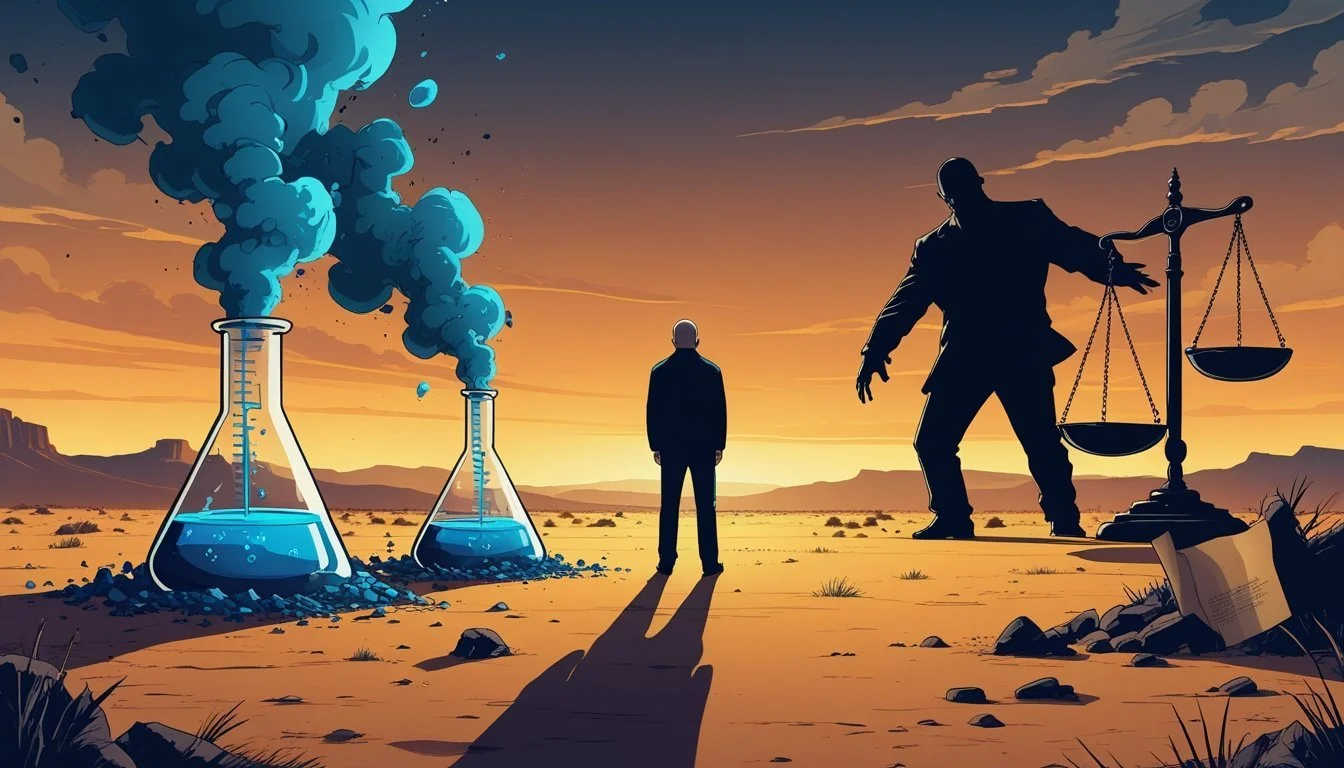
Breaking Bad's conclusion arises from an intricate web of personal decisions, moral conflicts, and an escalating sense of destiny. The finale, “Felina,” encapsulates the consequences of Walter White’s actions while confronting the promise and limits of closure.
Morality and Choices
Walter White’s journey from chemistry teacher to meth kingpin is defined by a series of ethical crossroads. Each decision, from lying to his family to escalating violence, transforms not just his fate but that of everyone around him.
The way Walter rationalizes his actions exposes the thin line between self-preservation and self-destruction. His initial motivation—providing for his family—becomes inseparable from his pride and desire for control.
In “Felina,” the finale, these choices culminate in irreversible outcomes. The moral ambiguity that propelled the series ultimately lands Walter and those he touched in situations with no easy escape, underscoring the significance of every decision made throughout the story.
The Nature of Closure
Closure in Breaking Bad is intentionally incomplete. The narrative addresses outstanding storylines but refuses simple resolutions for its central characters.
Walter White seeks redemption by settling scores and attempting to provide for his family one last time. However, the cost of his path prevents true reconciliation. Characters like Jesse Pinkman are left with the possibility—or impossibility—of moving on.
The ending answers essential questions but lets some consequences hang unresolved. This approach to closure mirrors life, where neat conclusions are rare, and lasting peace remains uncertain even after a decisive finale.
Fate and Inevitable Endings
From the early seasons, Breaking Bad establishes a sense of inevitability to Walter’s downfall. Subtle foreshadowing, visual cues, and symbolism throughout the series frame his fate as the logical end to a life ruled by escalating choices.
The finale, “Felina,” fulfills this trajectory. Walter’s self-destructive path leads to a violent conclusion that feels less like bad luck and more like destiny realized. Main events—such as the final confrontation and his own demise—underscore how past choices tightly bind characters to their ultimate ends.
Key events in the finale reinforce the notion that fate is shaped by action, not accident. The series uses structure and character arcs to show that certain endings are earned, not coincidental.
Major Players and Their Roles
The fates of Walter White’s family and law enforcement shaped the moral landscape and resolution of Breaking Bad. Key characters influenced the direction of the story and brought essential tension to the endgame.
Skyler and the Family Dynamic
Skyler, portrayed by Anna Gunn, navigated a difficult path once she learned about Walt's criminal activities. Her initial concern was protecting Walt Jr. (RJ Mitte) and their infant daughter, but Skyler’s involvement grew complicated as she became complicit in laundering Walt’s money.
She faced both emotional and legal consequences, struggling with isolation and fear. The show used Skyler’s choices to explore the cost of Walt’s actions on his family. Her transformation—from skeptical wife to reluctant accomplice—illustrated the personal toll of Walt’s descent.
Skyler's character anchored the family’s storyline, often acting as a voice of reason but also showing pragmatism when her family's safety was threatened. Tensions between Skyler and Walt intensified as the stakes increased, revealing deep fractures. Her relationship with Walt Jr. also became strained, highlighting the collateral damage to those closest to Walt.
Hank and the DEA's Pursuit
Hank Schrader, played by Dean Norris, represented both family and professional opposition to Walt. As a dedicated DEA agent, he pursued the “Heisenberg” case with unrelenting focus, unaware that the target was his own brother-in-law.
Hank’s investigation drove much of the series’ suspense, putting pressure on Walt and causing drama within the family. His tenacity and instincts pushed him closer to the truth, eventually leading to a confrontation that drastically changed the fates of many characters.
The conflict between Hank’s sense of justice and familial loyalty added complexity to his role. Law enforcement's involvement, led by Hank, provided a realistic depiction of the institutional challenges in stopping organized crime. The risks he faced as both a relative and a lawman elevated the emotional stakes, culminating in devastating consequences for the entire family.
The Antagonists: Forces Against Walt

Multiple forces emerge as principal threats to Walter White in the final season of Breaking Bad, shaping the course and inevitability of the story’s end. These antagonists complicate Walt’s life on both a personal and operational level, destabilizing his empire and hastening his downfall.
Todd, Jack, and the White Supremacist Gang
Todd Alquist (played by Jesse Plemons) becomes a critical figure after he joins Walt’s meth operation. His willingness to carry out violent acts without hesitation distinguishes him from earlier criminal partners. Todd gradually introduces his uncle Jack Welker (Michael Bowen) and the white supremacist gang into the operation, fundamentally escalating the level of threat.
The gang’s loyalty lies not with Walt, but with their own interests. They ultimately seize control of the meth business, double-cross Walt, and hold Jesse Pinkman captive, forcing him into slave labor. Unlike Gus Fring, their motivations are less about business acumen and more about pure profit and brutality, making them unpredictable opponents.
Their involvement leads to pivotal plot turns, including multiple murders and the ultimate unraveling of Walt’s plans. The white supremacist gang’s raw violence contrasts with earlier antagonists and raises the personal stakes by directly targeting Walt’s family and goals.
Lydia and International Links
Lydia Rodarte-Quayle (portrayed by Laura Fraser) adds a corporate and international aspect to the opposition Walt faces. As a Madrigal Electromotive executive, Lydia ensures meth distribution extends beyond the Southwest into Europe, making the operation exponentially more lucrative and risky.
Her paranoia and meticulousness keep her detached and difficult to outmaneuver. She relies on intermediaries like Todd for the violent aspects, but her influence is significant. Lydia is relentless about her own safety; she orchestrates hits and demands compliance, maintaining her position through both fear and leverage.
Her connection to international markets means that threats against Walt are not just local. Even after Walt attempts to leave the business, Lydia’s demands for high-quality meth and her capacity to order killings present an ongoing existential threat. She embodies the cold, calculating side of the drug trade that cannot be easily eliminated.
Symbolism and Plot Devices in the Finale
Key objects in Breaking Bad’s last episode double as both crucial plot tools and powerful symbols. Each device—whether deadly or deceptively mundane—embodies Walt’s tactical thinking and offers insight into his priorities at the end.
Machine Gun and Ricin
Walter White’s M60 machine gun is initially stored in the trunk, its presence kept ambiguous until the final sequence at the neo-Nazi compound. The weapon represents Walt’s foresight and willingness to rely on calculated violence. When unleashed, it is not used haphazardly, but as a surgical strike clearing out the compound, underscoring his mastery in planning and execution.
The ricin, on the other hand, is subtle and personal. Walt keeps it hidden for much of the series, and in the finale, he finally deploys it against Lydia. This choice shows a duality: the machine gun is brute force, while ricin is stealth and precision. Both tools reflect how Walt tailors his methods to fit the scale and intimacy of his revenge.
Rather than mere weapons, these devices become extensions of Walt’s character. They highlight his control over outcomes, serving as bookends for his journey from chemistry teacher to criminal mastermind.
The Lottery Ticket and Hidden Fortune
The lottery ticket scribbled with GPS coordinates to the buried barrels serves as both a literal key and a symbol of Walt’s secret life. To outward appearances, it is worthless, yet it holds the location of his entire fortune—earned through his criminal activities and stashed in the desert.
Possession of the ticket enables Walt to manipulate others, notably using it to force Skyler’s cooperation. The ticket also represents what’s left of his legacy. Ultimately, the hidden fortune cannot buy redemption or family reconciliation, but the ticket remains a physical reminder of what everything has cost.
In this sense, the lottery ticket is more than just a clever plot device. It stands for the double life Walt leads, and the consequences of his choices, making an ordinary slip of paper central to the downfall and resolution of his story.
Albuquerque: The Unique Setting

Albuquerque, New Mexico, provides Breaking Bad with its unmistakable backdrop. Its arid deserts, urban neighborhoods, and wide-open skies shape the show's visual identity and tone.
Unlike traditional television crime dramas set in dense cityscapes, Breaking Bad uses Albuquerque's landscape to emphasize isolation and transformation. The desert surroundings often serve as a silent character—witness to key events and emotional shifts.
Originally, the series was meant to unfold in Riverside, California. Production moved to Albuquerque largely for financial reasons, including attractive tax incentives.
This move had creative benefits. The distinctive Southwestern architecture, desert vistas, and long stretches of open road give Breaking Bad a memorable visual style that sets it apart from other series.
Some of the most iconic scenes—from clandestine meth cooks in remote stretches to tense confrontations under the harsh sun—could only have the same impact set against Albuquerque’s unique landscape. The contrast between the suburban normalcy and the surrounding wilderness highlights Walter White’s journey.
Key features Albuquerque brings to Breaking Bad:
Feature Show Impact Desert landscapes Symbolize isolation, moral decay Southwestern architecture Enhances the show’s visual palette Secluded roads and openness Convey opportunity and danger Local culture and urban grit Adds authenticity and tension
By choosing Albuquerque, the creators grounded the series in a specific place, lending it authenticity and shaping its narrative and visual tone.
Supporting Characters and Final Resolutions
The final episodes of Breaking Bad provide closure not only for Walter White, but also for the series' vital supporting cast. Their actions and outcomes reflect the broader consequences of Walter’s world, from legal maneuvering to final acts of loyalty or betrayal.
Saul Goodman’s Last Moves
Saul Goodman, played by Bob Odenkirk, leaves Albuquerque when the fallout from Walt's empire becomes too great. He arranges for a new identity, relying on the same "disappearer" service Walt uses. This decision effectively erases him from the direct line of fire.
His character’s exit is marked by a mixture of regret and self-preservation. Saul recognizes that his deeper involvement in Walt’s crimes puts his life and freedom at risk. He flees before law enforcement can catch up to him, a pragmatic but lonely end.
Saul’s final words and attitude during his last encounter with Walt are noteworthy. He distances himself from any sense of loyalty or friendship, instead focusing on survival. This closing scene sets up his future solo storyline in Better Call Saul, but in the context of Breaking Bad, it underlines how associating with Walt ultimately leads to isolation and paranoia.
The Fates of Secondary Characters
Badger and Skinny Pete play small yet pivotal roles near the end. Walt hires them to stage a convincing laser pointer threat, scaring Elliott and Gretchen Schwartz of Gray Matter Technologies into securing money for his family. Their willingness shows a lingering loyalty to Walt but also suggests they are not entrenched in deeper criminality.
Elliott and Gretchen, now wealthy at Gray Matter Technologies, become targets of Walt’s manipulations rather than direct victims. By the finale, their fate is left practically untouched, but they represent what Walt could have been—a figure who succeeded without resorting to crime.
The meth lab itself becomes the stage for the final confrontation. The site's machinery and chemicals, highlighted in the closing scenes, symbolize the consequences of every supporting character’s choices. Each secondary figure's resolution—flight, survival, or moral compromise—foreshadows the price of aligning with Walter White’s legacy.
The Impact and Legacy of Breaking Bad’s Ending
Breaking Bad’s conclusion left a significant mark on television, shaping how audiences discuss and remember serialized storytelling. Its ending influenced future crime dramas, set new standards for character-driven plots, and helped expand Netflix’s global audience for prestige TV.
Audience Reception
Viewers responded strongly to Breaking Bad’s final episode. Many felt that Walter White’s fate fit the direction of the story—paying the price for his actions as a drug kingpin while still managing to settle accounts with his enemies. Fan forums and social media showed a mix of appreciation and debate over whether the ending delivered true justice for all characters.
Netflix played a key role in spreading the show's popularity. International audiences discovered the series via streaming, enabling word-of-mouth buzz that was critical to its later success. The binge-watching model amplified emotional investment in the story and discussions about the finale.
Lists of best TV endings often include Breaking Bad’s finale. Some liked the sense of closure the episode brought, while others thought it avoided exploring the full fallout for Walt’s family and legacy.
Critical Perspectives on the End
Critics widely praised the narrative structure and the way the series wrapped up its main themes. Reviews highlighted the show’s willingness to tie up loose ends without resorting to melodrama or open-ended storytelling. The finale avoided glorifying Walter’s descent into criminality, instead presenting his choices and eventual downfall with clarity.
Some critiques focused on the clean resolution. Writers in publications like The New Yorker noted that Jesse’s escape and Walt’s calculated “revenge” made the conclusion neat, perhaps too tidy for such a morally complex series. Yet most agreed that the ending was a natural extension of the story’s internal logic.
Bryan Cranston’s performance and Vince Gilligan’s writing were singled out for allowing the audience to see the consequences of building a meth empire. The portrayal of Walter’s ego and struggle made the finale feel earned for both character and viewer alike.
Cultural Influence and Continuing Stories
Breaking Bad’s finale set a template for future TV dramas featuring morally ambiguous protagonists, such as Ozark and Narcos. Its storytelling approach demonstrated how meticulous character arcs could drive mainstream and critical success. The show’s emphasis on detail built a devoted fan base that continues to analyze its ending years later.
The series helped solidify Netflix as a destination for award-winning drama. Its impact contributed to the platform’s growth, making high-quality serialized television a staple for global audiences. Discussions about the show’s legacy often focus on how its ending shaped viewer expectations for closure and narrative payoff.
Continuing stories like Better Call Saul and El Camino expanded on events and characters from the original. These spin-offs probed the consequences of Walt’s meth empire, showing that Breaking Bad’s influence persisted in new stories and genres within television.
